A fairy hiding in plain sight as a human girl. A “forbidden” crush. A transformation in the final seconds, in which she rips her disguise off, revealing her true self.
Studio Adore uses vibrant animation to tell this striking story.
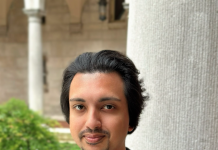
“I want it to be beautiful but also visceral and horrifying,” said Michelle Cao, who is co-director at Studio Adore, along with her former classmate Angie Orbeta.
Cao never went to animation school or found a way in the industry’s conventional path, so she built her own studio instead. She is a pre-med student at North Seattle College, and runs EMT street patrols with the International District Emergency Center on weekends. Animation happens in the remaining hours she has free.
The studio’s latest film, The Changeling, is set in a 1980’s Chinatown, unfolding in a boarding house. The studio created a team of 24 to dive into an animated story of fantasy, horror, and romance while displaying the rich history of the neighborhood across a 90-second video. It was funded by a grant from 4Culture.
Cao sat down with Travis Quezon with the International Examiner to discuss the project’s origin, the research that shaped it, and why she set the story in Seattle’s Chinatown International District (CID)
International Examiner: Before we get into the project, can you tell us a bit about yourself?
Michelle Cao: My position at Studio Adore is co-director, which basically means I wear all the hats and I make sure the things get done when they need to get done. In terms of my regular gig, I’m a full-time pre-med student at North Seattle College, and I do volunteer EMT work with the International District Emergency Center.
IE: Tell me more and your project and why you wanted to do a fantasy horror anime set in CID?
MC: I was very much an artsy kid, and I saw animated shows that were gorgeous. I remember seeing them and just being like ‘I think that’s what I’m going to do when I grow up.’ It was always in the back of my head. I went through life, graduated college, and went into an industry that was basically exploitative.
A lot of mid-career folks that I knew couldn’t even find a job. I did not go to an animation school, I was never really good at being able to catch the eye of a recruiter or really follow the conventional route into the animation industry.
I was still unemployed in that industry, which is funny. But it’s still a childhood passion of mine. I think many others and I go into it because, as artists, there’s things we want to explore, stories we want to tell, all that heart in our souls. I still wanted a way to express that. I guess naturally, founding an indie studio was the next step for that.
I approached my co-director Angie Orbeta. She’s an old classmate of mine. From there we developed it, and we collaborated with a bunch of artists as we solidified the idea more to get it to a pitch-able state.
The amount of community activism and just spirit of the district is nothing I’ve seen anywhere else in Seattle. Being really inspired by that, it was kind of just a lot of things leading from one to the other.
IE: Tell me about putting this team together and making this vision a reality.
MC: Our crew for the trailer proper was 24 people. We had to go through the interview hiring process. Finding the people was its own challenge. We were able to fill a few just with who we knew, and then the rest we did some calls.
IE: What is the intentionality behind setting your story in the CID specifically in the 80s?
MC: I’m originally from Georgia, and I think a lot about our education there. A lot of it was full of gaps — a lot of straight-up not mentioning people who aren’t white.
In college, I had a critical theory class, and we were reading an article, and I remember there was a picture of Malcolm X next to an Asian woman. I remember just really being taken aback by that image, and when I broke down that feeling, I was like, there are Asian Americans in the civil rights movement. This is something I hadn’t even thought of before… and I totally never heard about this.
IE: Were there any artifacts of Chinatowns in the 80s that stood out for you when deciding which artifacts to put in your animation?
MC: The floor plan was highly inspired by Yick Fung [storefront] preserved by Wing Luke Museum. It was really interesting just seeing the age of the objects but also the modernity of a lot of the objects.
I think it’s shot three where there’s a TV and it’s showing a VHS and we literally looked at the TV you see in Yick Fung today of playing Jimmy Mar on it.
l was speaking with Devin Cabanilla of FANHS, [and] of Filipino Town. He told me a lot about his growing up, especially in the 80s. One thing he mentioned was the house he grew up in also functioned as a boarding house, and so we took a lot of cues from that. Sometimes they would have social events really late at night, just like partying, and as a kid he would sleep with his grandparents on the floor cause sometimes it goes really late, and you just want to stay where you are. They would roll out, I think, the straw mats. We went to our props designer, Morgan, and Angie did a great job with that.
It was a really cool moment where Angie and Morgan pulled together a bunch of references and different patterns, and then that became the straw mats. You see an overhead shot where the counter kind of forms an L and then the two main characters are on straw mats, just like sleeping behind the counter.
IE: On the surface, it can be seen as a love story, but there is much more going on; can you speak to that level of detail and symbolism?
MC: It works on multiple levels. It’s the story of this young woman, Maria, having the fate of having a crush on her coworker. But also having an inferiority complex from the various circumstances she grew up in and feeling that affection or love or expressing that and having a crush is a psychosis for her. On a deeper level, it comes from her being a black sheep in her community and even more so in the community outside of that her whole life. She’s struggling with even wanting things or feeling like she deserves to want things cause she feels like she’s so wrongfooted in this world that any desire is just like she doesn’t even deserve it.
Maybe it’s not even a question of deserving, but she is so in her head and not set up to thrive, succeed, or align with this world that she wouldn’t want to put that on anyone else. It also speaks a little bit to how romance is kind of objectified a lot in society, and she’s also kind of falling prey to that a little bit, but in her head, if she gets the object of her affections, if she gets the girl, then that’s equated to happiness, which that’s not necessarily how that works.
But then also with the plotline of the horror and the twist of it at the end where this girl Maria and her fairy form is forcibly revealed. She learns it’s like I wasn’t even human all along. That is a really interesting moment for me because I like to think of it as it’s kind of like a moment of horrifying realization and being terrified by that, but also an opportunity for absolution now that it everything’s out on the table essentially. There are no more secrets.
IE: In a perfect world, what’s next for Studio Adore?
MC: I definitely want to set up a studio that has a better system than most of what we’re seeing in the animation industry of being highly exploitative. It should separate animators and creators from the incredible profits that their creative labor has earned corporations everywhere.
For me, ideally, I wish there was more of a diverse and well-rounded ecosystem for smaller, mid, and large studios so that there weren’t just five big studios that you could possibly work at, and if you work there, you have to sacrifice a lot of your creative vision, but if you don’t, you don’t have a job and can’t eat. I think ideally we could set up The Changeling as a series because those are really consistent employment for animators.