Libraries and museums serve as cornerstones of communities, providing access to information, fostering education, and supporting well-being. The Institute of Museum and Library Services (IMLS), an independent agency of the federal government, has played a crucial role in supporting libraries, historical societies, and museums across the nation, ensuring they can continue to serve their communities effectively.
But now this important source of support is under threat. On March 14, the White House issued an Executive Order directing the elimination of the IMLS. And on April 3, the federal government informed Washington state it was cancelling the IMLS block grants to our state, as well as to California and Connecticut.
In response, the national legal organization Democracy Forward filed a federal lawsuit on behalf of the American Library Association (ALA) and the American Federation of State, County and Municipal Employees (AFSCME), the largest union representing museum and library workers, to prevent irreparable harm to libraries and museums. The lawsuit underscores the nonpartisan importance of these institutions in preserving the history and vitality of our democracy, citing statements from Benjamin Franklin, former U.S. Presidents Dwight D. Eisenhower and George W. Bush, and the U.S. Supreme Court.
IMLS funding has profoundly shaped libraries, museums, organizations, and programs in Washington state.
Ron Chew, an author, former Executive Director of the Wing Luke Museum, former editor of the International Examiner, and Trustee of the Seattle Public Library (SPL), emphasized that while the majority of funding for SPL comes from the City of Seattle’s general fund and the 2019 Library Levy, IMLS-supported programs have provided substantial benefits. Over the past five years, IMLS sponsored an SPL-led project with nearly $500,000 of funding to support teen mental health in the wake of the COVID-19 pandemic. This project has built capacity for libraries nationwide to support teens’ wellbeing, engaging teens and undergraduate interns in co-designing mental health supports.
Tom Fay, Chief Librarian of SPL, noted that although the majority of SPL’s funding is from local sources, the loss of this funding will be significant for other libraries across the state. Fay also pointed out that IMLS represents less than 0.003% of the annual federal budget, and is very efficient in its operations. “Each state grant is tailored to the needs of that state and is productive,” Fay said.
Fay said IMLS funding has been instrumental in supporting historically marginalized collections and digitalization efforts throughout the state. IMLS supports SPL database subscriptions that have made important resources available to the community, including primary sources, e-books, Thorndike large print books, up-to-date databases on articles, journals, magazines, podcasts, learning services, and language services. At SPL, IMLS funding has helped support digitizing local history collections, including of Seattle’s Black history, and has provided subsidized access to research and information databases.
Fay also underscored the significance of free library services and meeting spaces, which are increasingly rare today. “Libraries are able to bring patrons closer to materials,” Fay said. “IMLS is all about access to information that allows humans to grow.…The public library is one of the few places you can visit for free and have access to resources for free.”
Sara Jones, the Washington State Librarian, emphasized the profound impact of IMLS funding on small and rural libraries.
She also recalled how federal grants like the CARES Act provided internet connections, research databases, and purchased shared eBook platforms. “During the pandemic, the most important thing we did was make libraries’ Wi-Fi strong enough to reach parking lots and communities to access Wi-Fi,” she said. “There was not enough Wi-Fi power for families, even with resources that didn’t have the bandwidth to do digital learning inside their own homes when schools were 100% online. Across the nation, all hardware and software were reconfigured and cross collaborated, a small amount of money in each state helps existing institutions preexisting assets work stronger and faster. Libraries were and are nimbler on working and activities than public and private schools, within weeks.”
Jones stressed that the loss of IMLS funding would have a devastating impact on library services, particularly for underserved communities. “Small towns have been helped to obtain internet connections and research databases at a discount rate,” she said. “It is difficult for [these towns] to obtain staff with master’s degrees, and we help them triage their needs.” Without IMLS funding, she said, “you will lose a lot of staff who have master’s degrees specialized in library and information science.”
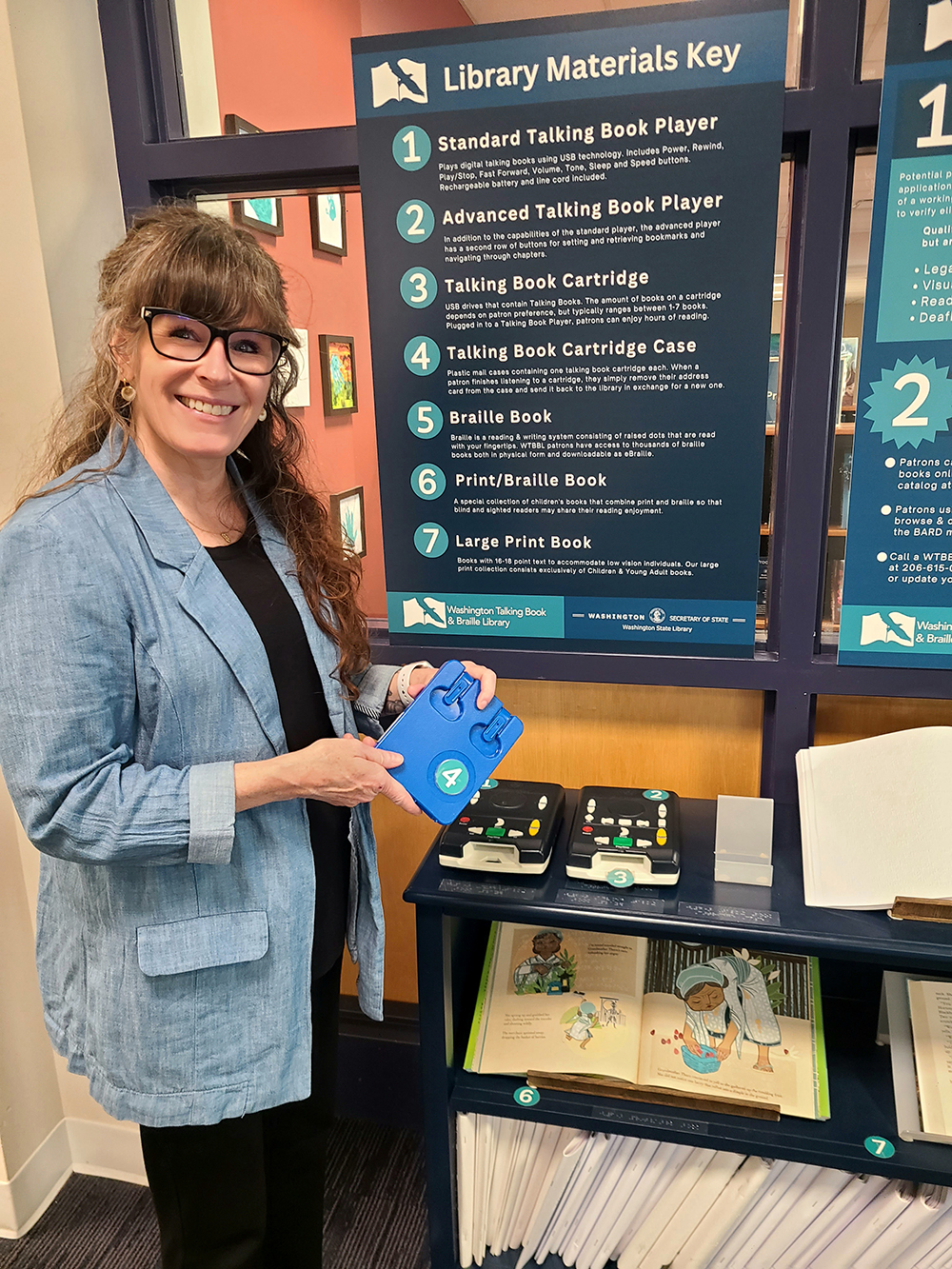
Danielle Miller, Executive Director of the Washington Talking Book and Braille Library (WTBBL), said IMLS funding plays a critical role in supporting services for individuals with print disabilities. She emphasized the importance of personalized service, assistive technology, and the production of accessible materials. WTBBL offers Braille and Audio Reading Download (BARD) books, VoiceOver training, and assistive technology workshops. Miller warned that the loss of IMLS funding would severely curtail these services, leaving patrons without the support they need to access reading materials and technology.
“Changes in IMLS funding will end our ability to offer our patrons access to Bookshare subscriptions; decrease resources that we use to keep our technology and equipment current in our local book production departments; and end programs that we offer our patrons, like VoiceOver training, one-on-one training to use assistive technology; will close our patron computer lab; and will stop supplemental services we offer like monthly recommended reads lists and reader support,” Miller said.
John Pai, WTBBL Audio Production Supervisor, performs “sound sweetening” as part of his job, ensuring that audiobooks sound smooth. Pai and Miller highlighted the Wing Luke Museum’s partnership in creating one of the first immersive talking book and braille books of a graphic novel: We Hereby Refuse: Japanese American Resistance to Wartime Incarceration, by Frank Abe, Tamiko Nimura, Ross Ishikawa, and Matt Sasaki.
Pai emphasized the importance of IMLS funding in supporting the production of graphic novels like this with integrated image descriptions. “It’s an immersive audio and braille experience for the graphic novel that we hope becomes a model for other graphic novels that are transformed for sensory impairments in the future,” he said.

The inability to create new talking and braille books will have negative global impacts for all talking books and braille libraries, Miller said. The Marrakesh Treaty, adopted in 2013, aims to facilitate access to published works for persons who are blind, visually impaired, or otherwise print disabled. It requires member countries to implement copyright exceptions that allow the creation and distribution of accessible formats, such as braille, audio, and large print books. The treaty is crucial in addressing the global book famine, wherein only a small percentage of published works are available in accessible formats. Without IMLS funding, the ability to produce and distribute accessible materials would be severely impacted, limiting access to information for individuals with print disabilities.
Leonard Forsman, Tribal Chairman of the Suquamish Nation and Board President of the Suquamish Museum, said tribal libraries and museums would be impacted by the loss of IMLS funds. Forsman said IMLS grants have supported exhibits, oral history projects, and cultural preservation efforts.
“Collections Access are helping preserve and revitalize traditional indigenous cultural knowledge, regalia, traditions, language, science, and culture,” Forsman said. He said the loss of Native American Library Services Enhancement Grants, which are funded by the IMLS, would hinder the ability of tribal libraries and museums to implement community-driven projects – for example, the 2009 Centennial Canoe Journey, and education about fishing rights. “As a tribe, then, we didn’t have a lot of income,” Forsman said. “We needed federal funding grants to subsidize archival research and photograph documentation. Library resources grants provided important historical research opportunities to express our culture through the expression of useful structures.”
“IMLS grants give us an opportunity to include partnerships with international tribes, states, and museums like the Burke Museum of Natural History and Culture,” Forsman continued. “This process helps Lummi, Suquamish, and the Burke museums to grow our programs. The state gave us our Centennial, we were really engaged to gather data, materiality, as museum institutions to contribute to the atmosphere in our lives.”
Danielle Morsette, a world-class weaver working in the Coast Salish tradition, said IMLS funding helped support her work. “My first blanket was a tribute to the Bill and Fran James blanket in the Suquamish Museum Collection,” Morsette said. “This particular blanket was the first one that called me to weaving. I remember seeing it as a little girl. Though I was never their direct student, I have so much respect for them and the influence they had on me as a weaver. Their work showed me what was possible, and I carry that with me in everything that I create.”
Brian Carter, Executive Director of 4Culture and former Deputy Director of the Northwest African American Museum (NAAM), noted that IMLS helped fund NAAM, which was a 2019 IMLS National Medal finalist. He said IMLS grants have supported capacity building, professional development, and infrastructure improvements at the museum. Carter said IMLS helped fund internships from UW Museology programs, which have helped transition interns into curatorial, educational, and archival professionals. Once such individual who was helped by this program is Chieko Phillips, the Heritage Program Director of 4Culture. Carter warned that the loss of IMLS funding would destabilize museums and libraries, leading to reduced services, opening hours, and staff. “Libraries are places of trust and guidance and institutions,” Carter said. “We lose those people that inspire us and knowledge we are seeking with our lives.”
Brandon Taft, Library Technician and Website Manager of the Jamestown S’Klallam Library, highlighted the Primetime Family Reading Program, which is made possible by Humanities Washington, which is in turn supported by the endangered National Endowment of Humanities (NEH), and provides family educational engagement that develops ways in which S’Klallam families can sustain their relationship with the plants, waters, and the land.
Taft emphasized the importance of IMLS funding in supporting the acquisition of books and preserving culture. IMLS supported the creation of an accessible digital museum with special collections and oral histories called the House of the Seven Generations. “IMLS-grant work played a huge part in their development,” Taft said. “Through IMLS grant work and the hard work of staff, the Jamestown S’Klallam Tribal Library became a space worthy of the IMLS 2019 National Medal Award for Museum and Library Services. Which helped fund our new library and exhibit space, further ensuring the preservation of Jamestown S’Klallam Culture.”

Leonard Garfield, Executive Director of the Museum of History and Industry (MOHAI), said IMLS funding significantly supported the museum’s digitization efforts through the Digital Humanities grants. MOHAI was able to digitize its photographic collection, the largest digital photographic collection on the West Coast. This digitization has made the collection accessible to people beyond Seattle. MOHAI’s digitization efforts emphasize historically marginalized stories, such as the Al Smith Collection by a Black photographer, and have involved creating accurate and culturally appropriate descriptions for photographs.
MOHAI has implemented several accessibility features to make its exhibits more inclusive and accessible to a broader audience including closed captioning, multilingual resources, visual descriptions, and tactile exhibits. The museum has received $700,000 in support for accessibility, which has been used to provide broader abilities, disabilities, innovation informal education, and cultural representation in numerous projects, such as the Curatorial Fellowships. These fellowships bring together cultural community advisory groups, providing platforms created from diverse community perspectives. The fellowships have benefited significantly from IMLS funding, which has supported various initiatives aimed at promoting equity in storytelling.
Other public programs, such as History Café and summer camps, are privately funded, but with the loss of federal funding, private funding will be reallocated to digitization and stewardship of collections, and accessibility. “The loss of IMLS funding would have a devastating impact on our ability to support these fellowships,” Garfield said. “These programs are essential for fostering diversity and inclusion in our curatorial practices. Without them, we risk losing the valuable insights and contributions of BIPOC communities.”
“We are lucky to have such a philanthropic community — but we will have been harmed,” Garfield continued. “The most important federal partner has walked away and that is very unfortunate.”
Garfield warns of the negative impacts IMLS dissolution will bring in the future: “We would be smaller, less effective,” he said. “We would change less and move toward the future with timidity. We will no longer be able to be ‘bigger, better, and broader.’ Museums and libraries won’t go away. They won’t evolve with our community, reflect our community, and won’t provide resources to be stronger, reflect, and grow.”
Helpful Links: