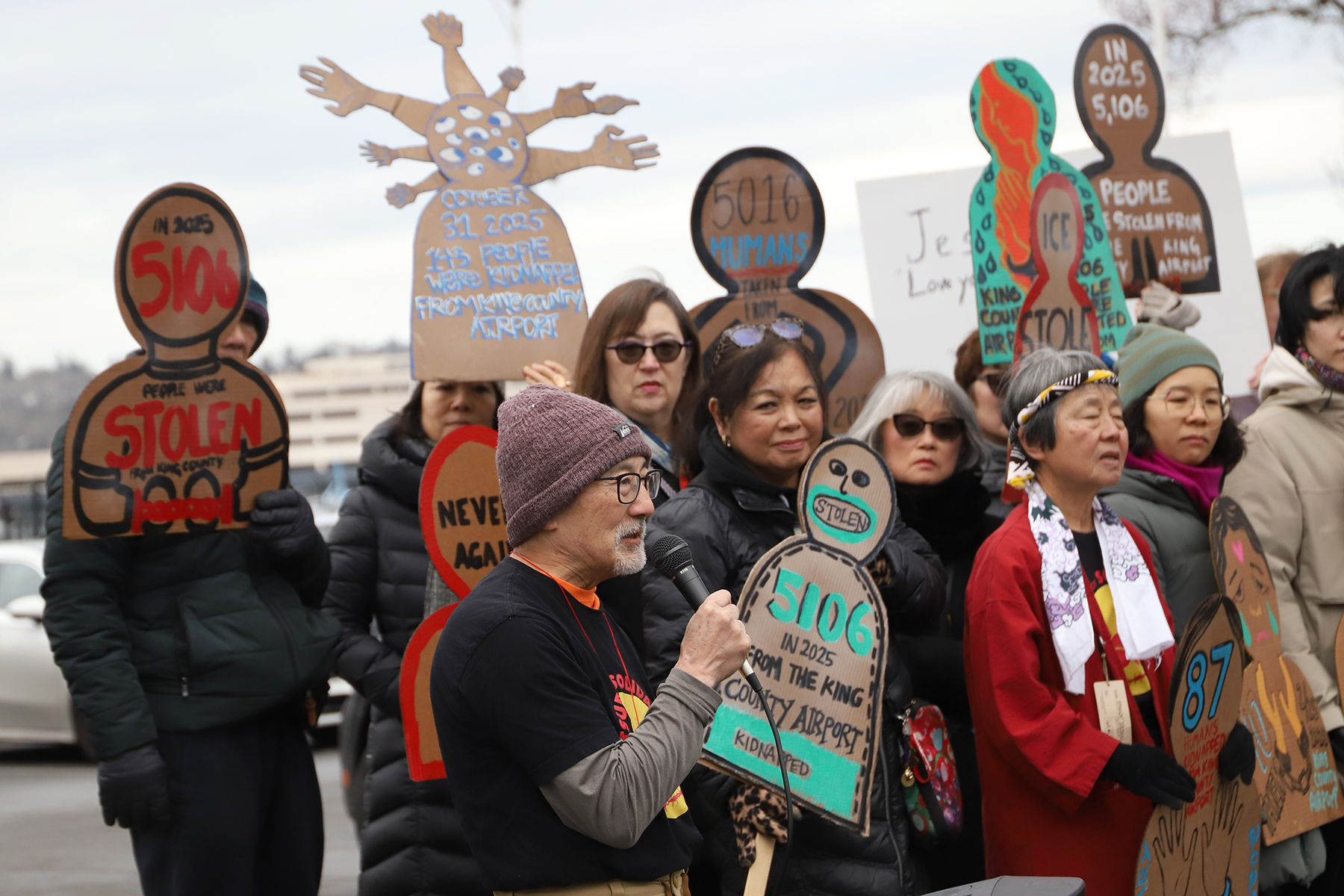
On February 19, Tsuru for Solidarity and La Resistencia held a protest and press conference at King County International Airport to mark 84 years since President Roosevelt signed Executive Order 9066, which authorized the forced removal and incarceration of more than 125,000 Japanese Americans. The airport, also known as Boeing Field, is being used by Immigration and Customs Enforcement (ICE) to contract private companies for deportation flights.
Kiku Hughes is a fourth-generation Japanese American whose grandmother and great-grandparents were incarcerated during World War II at Topaz, a concentration camp in Utah. She is also co-chair of the Police, Prisons and Detention Campaign at Tsuru for Solidarity.
“I really think it’s important to emphasize that the Japanese American community gets to dictate how our history is remembered,” Hughes said. “We are, as a group, standing up and saying that this is a repetition of that history. In 80 years, we’re going to be looking back at this time in history in the same way as we look now at World War II incarceration.”
Art as a tool
The Day of Remembrance event featured artwork by Erin Shigaki documenting the numbers of individuals deported at the airport.
Shigaki is an artist and fourth-generation Japanese American born and raised in Seattle. She also runs an annual pilgrimage to Minidoka, the concentration camp where members of her family were incarcerated. As part of Tsuru for Solidarity, she organized an art build session at the historically Japanese American church St. Peter’s Episcopal, where over 80 participants made 100 human figure signs, which were highlighted at the press conference.
“It seemed like a doable project to have these human-shaped cutouts, including the data and shackles on the wrists,” Shigaki said. “Of course, these signs cannot fully depict the fact that people are also shackled at the waist and the ankles.”

Volunteers from Tsuru for Solidarity and La Resistencia have documented people having their hands shackled to their waist, wrists, and ankles as they board flights.
Shigaki plans on reusing the art pieces every month at future rallies, events and press conferences. She also hopes to move them into storefronts throughout Seattle and organize more art builds.
While Seattle has not yet had escalations with ICE seen in other cities like Minneapolis, the Day of Remembrance event is part of the ongoing efforts to highlight the use of mass deportations at a publicly owned and operated facility within city limits.
“I sort of get the feeling that folks are waiting for something big and violent, like what happened in Minneapolis, before they take it seriously,” Shigaki said. “We just want to let people know, it’s been happening. We can’t wait for that moment. I don’t see the point. I think there are things we can do now. I think we can pressure county politicians and pressure on the airport and the companies that it contracts with because that’s already been working for us.”
The legal battle
The airport has been used for deportations since 2011, according to the University of Washington Center for Human Rights. Josefina Mora-Cheung is the director of organizing at La Resistencia and says their advocacy efforts led King County Executive Dow Constantine to bar deportation flights in 2019, citing human rights abuses. This prompted ICE to begin using an airport in Yakima as a site.
In 2020, the U.S. Department of Justice sued the county for violating the Supremacy Clause of the U.S. Constitution and the Airline Deregulation Act, which prohibit local governments from enacting laws related to air carrier service. By May 2023, the deportation flights resumed at the airport. In 2024, a federal appeals court ruled in favor of the Department of Justice.

Before he left office, Constantine issued an executive order to increase transparency by publishing a dashboard that includes live stream cameras and flight logs. However, Mora-Cheung said this has not been enough to provide clear information regarding how many people are being deported.
“One of the big issues that we’ve been having as a community observing group is that we’ve basically been having to do the King County Airport’s job for them,” Mora-Cheung said. “We are really limited in how we’re able to observe. We have a lot of issues with even seeing the live stream cameras. They sometimes don’t work.”
Mora Cheung believes it should be the responsibility of the airport and ICE to transparently report the numbers of people being moved each week.
On February 12, King County Executive Girmay Zahilay signed his first executive order to upgrade security cameras and improve public observation areas at the airport, in an effort to improve immigration oversight.
Strategy shift
As a result of the judicial upholding of the use of King County airport as a deportation site, activists have turned to pressure campaigns against private companies such as Sky Service, a fixed-base operator (FBO) servicing ICE flights, and Signature Aviation, a company backed by Bill Gates.
“We also believe that targeting these companies is really important because they have a big role to play and they’re profiting off of people being ripped from their communities,” said Mora-Cheung.

On February 14, La Resistencia protested at Sky Services offices at the airport to demand an end to ICE contracts, but were asked to leave the private property.
La Resistencia is also focusing on data collection to provide oversight on flights. In a report published in July 2025, the organization documented 42 flights between January 1 and June 30, 2025, with 1,342 people from the Northwest ICE Processing Center (NWIPC), also known as the Northwest Detention Center, boarded for deportation or transfer. 913 people arrived at the airport on an ICE flight and were subsequently taken to the NWIPC.
Data is frequently updated on the La Resistencia Instagram page. Most recently, on February 28, 2026, volunteers observed deportation flights where nine people boarded a plane to be transferred or deported, and 12 people came off the plane to be detained at NWIPC.
On February 21, Tsuru for Solidarity and La Resistencia hosted another Day of Remembrance event at the Washington State Fairgrounds in Puyallup, the site of the largest WWII Japanese American incarceration camp in the state. Mora-Cheung said the coalition’s long-term plans are to find a way to shut down the detention center for good, and prevent ICE from expanding operations.

Hong Ta (she/her) is a news writer from South Seattle and grew up going to the CID, specifically in Little Saigon. She graduated from the University of Puget Sound with degrees in Political Science and Spanish. You can read more of her work at thienhongta.com.