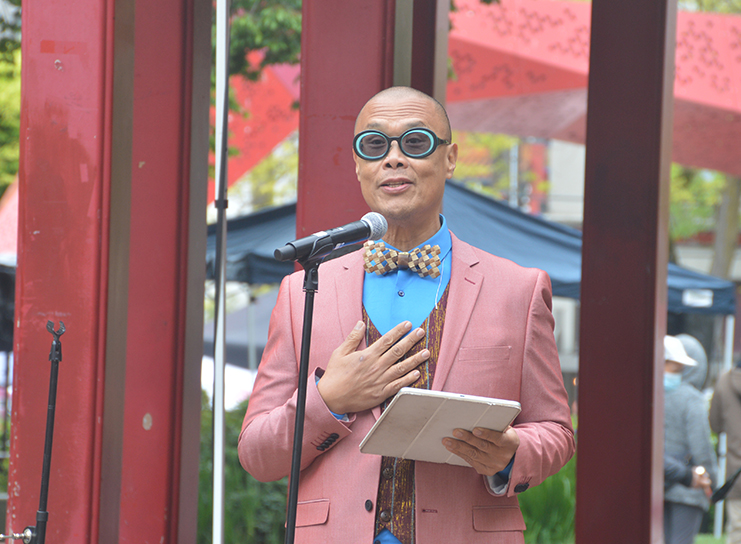
(Editor’s note: This piece originally stated that Joël Barraquiel Tan was the Wing Luke Museum’s third director, but they were in fact the museum’s fifth. Peg Marshall was the first paid director of the Wing, and Kit Freudenberg was the second. Ron Chew served as the museum’s third director, followed by Beth Takekawa and then Joël Barraquiel Tan. The error has been corrected.)
Joël Barraquiel Tan stepped down as executive director of the Wing Luke Museum after two-and-a-half years, the museum announced in a September 13 newsletter to members.
Barraquiel Tan (who uses all pronouns) said many factors went into the difficult decision, from navigating challenges in the Chinatown International District (CID) neighborhood to personal wellness. Two other, high-profile factors included a hate crime attack on the museum last September, and public controversy over language in an exhibit related to anti-Semitism that referenced the Israel-Gaza conflict.
In May, a group of museum workers staged a walkout protesting a panel in the exhibit which they said falsely equated calls for Palestinian solidarity and critiques of Israel as terrorism and anti-Semitism.
“After some deep and personal searching, I realized that it was better to let go at this point for a personal reset as I’ve been feeling a strong calling to spend more time with family and my own health goals,” Barraquiel Tan said in a written statement shared with the International Examiner.
The museum appointed Kamahanahokulani Farrar Law as interim director in mid-September. She previously served as the Museum’s senior director of Finance and Operations. The Wing’s Board of Trustees will begin a search for the new permanent director
Barraquiel Tan joined the museum in 2022 during the tail-end of the COVID-19 pandemic as the museum’s fifth director, following previous directors Ron Chew and Beth Takekawa. Their ascension marked the Wing’s first change in leadership in nearly 15 years. Barraquiel Tan joined as the Wing’s first queer director, first foreign-born director, and first director of Filipino descent to lead the museum in its 54-year history.
Before coming to Seattle, Barraquiel Tan lived on Hawai’i Island and helped develop the community organization Vibrant Hawai’i. He also co-founded the Los Angeles Asian Pacific AIDS Intervention Team Health Center, and was Director of Community Engagement at Yerba Buena Center for the Arts from 2004 to 2015.
Barraquiel Tan said she knew the job leading the museum during the pandemic would have challenges, but that the onslaught of difficulties she faced became overwhelming. Barraquiel Tan was outspoken about the potential harms of Sound Transit’s plans for a second light rail station in the CID. She also cited public safety concerns such as arson and shootings close by the museum, as well as drug-related issues on 12th and Jackson Street, as factors in her decision to step down.
On September 15, 2023, when the museum was attacked by a 76-year-old man wielding a sledgehammer, Barraquiel Tan expressed the view that the attack would take the museum a long time to heal from. “This kind of grief and trauma has a really long tail,” they said in an interview with the Examiner at the time.
Stanley Shikuma was inside the museum during the attack, and paraphrased the attacker’s words: “‘The Chinese are to blame, they’ve ruined my life. Something has to be done about them. That’s why I came to Chinatown. Because I’m going to take care of it.’”
The man, identified as Craig Milne, 76, was arrested and charged with a hate crime and first-degree malicious mischief. He served six months in jail before being released, earlier than the nine months the Wing requested, according to museum spokesperson Steve McClean. Milne pleaded guilty of a felony hate crime as part of the terms of his sentence and release, which also included 12 months of probation, a restitution amount to be determined, and a No Contact Order on behalf of the museum, prohibiting him from approaching the building.
“Mr. Milne, as a veteran, secured housing through the VA, though we cannot confirm where,” McClean added in an email.
The Wing temporarily covered the broken windows with boards and installed murals on them. The windows in the Canton Alley Historic Storefront have since been repaired with the help of $100,000 from the Governor’s office and Mayor’s office.
Months later, on May 22 2024, a group of 24 Wing staffers staged a walkout over concerns about a panel in the museum’s Confronting Hate Together exhibit.
The panel in question included the following sentence: “Today antisemitism is often disguised as anti-Zionism, with Jews everywhere expected to defend the actions of Israel’s right-wing government.”
It also said: “On University campuses, pro-Palestinian groups have voiced support for Hamas (which is classified as a terrorist organization by the US government) and a Palestinian state stretching ‘from the river to the sea,’ a phrase defined by the erasure of Israel.”
Confronting Hate Together was planned as a temporary pop-up installation created in partnership between the Wing Luke Museum, the Washington State Jewish Historical Society, and the Black Heritage Society of Washington State, in response to rising racism and anti-Seimitism. The exhibit explores bias and prejudice in the Asian, Jewish, and Black communities.
Before the walkout, the group of Wing workers raised concerns that language in the panel mischaracterized Palestinian solidarity movements as antisemitic and aligned with terrorism, but the panel was unchanged, according to a timeline shared by the group in Instagram, an account called Wing Luke Museum Workers (@wlm4palestine).
“Our solidarity with Palestine should be reflected in our AA/NHPI institutions,” the group wrote in a May 23 Instagram post. “It sets a dangerous precedent of platforming colonial, white supremacist perspectives and goes against the Museum’s mission as a community-based museum advancing racial and social equity.”
The museum subsequently announced plans to relaunch Confronting Hate Together at a different location, and said it was “unwaveringly committed” to the exhibit.
Looking back, Barraquiel Tan wonders if he could have slowed down the volatility of the situation. Now and at the time, he held a neutral attitude toward the controversy over the exhibit. He said he had compassion for those on both sides regarding the exhibit panel, and was not willing to pronounce one side or the other as having the correct perspective.
“I believe the staff who criticized the exhibition did it in a way, and pointed out issues that deserve that kind of respect, of consideration,” said Barraquiel Tan. He continued: “To deal with that level of complexity and to have it happen so publicly via social media and via the kind of international, national, local press, kind of drowns out the ability to understand what the complexities are… I still am of the belief that we have to remind each other that we need to be able to talk to each other and stay in the room even when it’s difficult.”
On July 2, the Seattle Times published an editorial by Barraquiel Tan, reflecting on her experience with the controversy and lessons learned, including the need to “straddle multiple realities,” “champion both/and,” “prioritize relationships.”
In the editorial, they also noted that large institutions like universities are “experiencing increasing internal fractures triggered by complex global events.”
“Unlike universities and larger organizations, grassroots BIPOC-led organizations, like ours, don’t have the resources to survive prolonged crises,” Barraquiel Tan wrote.
In an interview with the Examiner, Barraquiel Tan clarified that fracturing and disagreements within institutions aren’t always destructive and can be productive and clarifying, but too often can take the form of “cancellation.”
“I’ve canceled in my activist past: the Reagan Administration, LAPD, etc.,” he added in a written statement shared with the Examiner. “You know, I came up in the HIV AIDS era, but we were both canceling and building, right? So I’m not saying that that’s not happening now, but it’s not happening quick enough, especially for really vulnerable BIPOC organizations.”
Barraquiel Tan said the walkout and its aftermath were a wakeup call for the museum, which reexamined practices and procedures.
Barraquiel Tan isn’t sure what’s next for her life and career, and whether that means staying in Seattle or moving to California or somewhere else.
“People forget that Joël served as director of the Museum during a highly compressed window of challenges,” said Ron Chew, the Wing’s third director, in a statement. “He helped guide the institution through enormous budget changes, a fierce pandemic, a wave of anti-Asian hate and crime and homelessness in the neighborhood. It took unrelenting tact and resourcefulness to make it through each day, each week, each month. It takes a toll.”