It’s not often that you get to be at the center of three big celebrations in two weeks. But that’s exactly what happened to community icon Dolores Sibonga last month.
First, Seattle Mayor Katie Wilson, highlighting Sibonga’s many accomplishments as the first woman of color on the Seattle City Council and praising her recently printed memoir “The Best Adobo in Town: From Café to City Council,” issued a proclamation declaring August 12 as Dolores Sibonga Day.
The proclamation noted that Sibonga, who first joined the Council in 1978, served three terms. She led the push for Seattle’s first affirmative action ordinance and championed the city’s parks and recreation system. She helped represent the economically fragile Chinatown International District where she had strong roots, having grown up in her family’s Filipino restaurant, the Estigoy Café. She was the first Filipino American attorney admitted to the Washington State Bar. She and her late husband Martin Sibonga published the Filipino Forum, which covered coalition-led civil rights work.
Second, King County Executive Girmay Zahilay and the King County Council issued its own proclamation, designating August 18 as Dolores Sibonga Day. The Council cited her work on behalf of affirmative action, workers’ rights and economic development. Daughter Randi Sibonga accepted the award from the Council on behalf of her mother, who has been in frail health.
Dolores Sibonga served on the King County Board of Appeals for 20 years, handling property tax appeals. In 2017, Sibonga and Joan Yoshitomi created the Ruth Woo Emerging Leaders Fellowship to provide disadvantaged young people with government work opportunities in King County. Sibonga and Yoshitomi are long-time members of the Asian Pacific Women’s Caucus.

Sibonga helped lift and support the careers of many Asian American women leaders including Yoshitomi, Velma Veloria, the first Asian American woman in the Washington state legislature, retired administrative law judge Vivian Luna, and Martha Choe, the first Korean American City Council member.
Third, on August 12, Sibonga celebrated her 95th birthday at her apartment at Merrill Gardens in Renton. The low-key party featured a vanilla ice cream birthday cake from Dairy Queen and two of Sibonga’s choice dishes: house special chow mein and sweet-and-sour spareribs from Tai Tung Restaurant. In attendance were Sibonga’s daughters Theresa Escobar and Randi Sibonga, Randi’s husband Bart L. Shilvock, and Theresa’s daughter Maya Escobar.
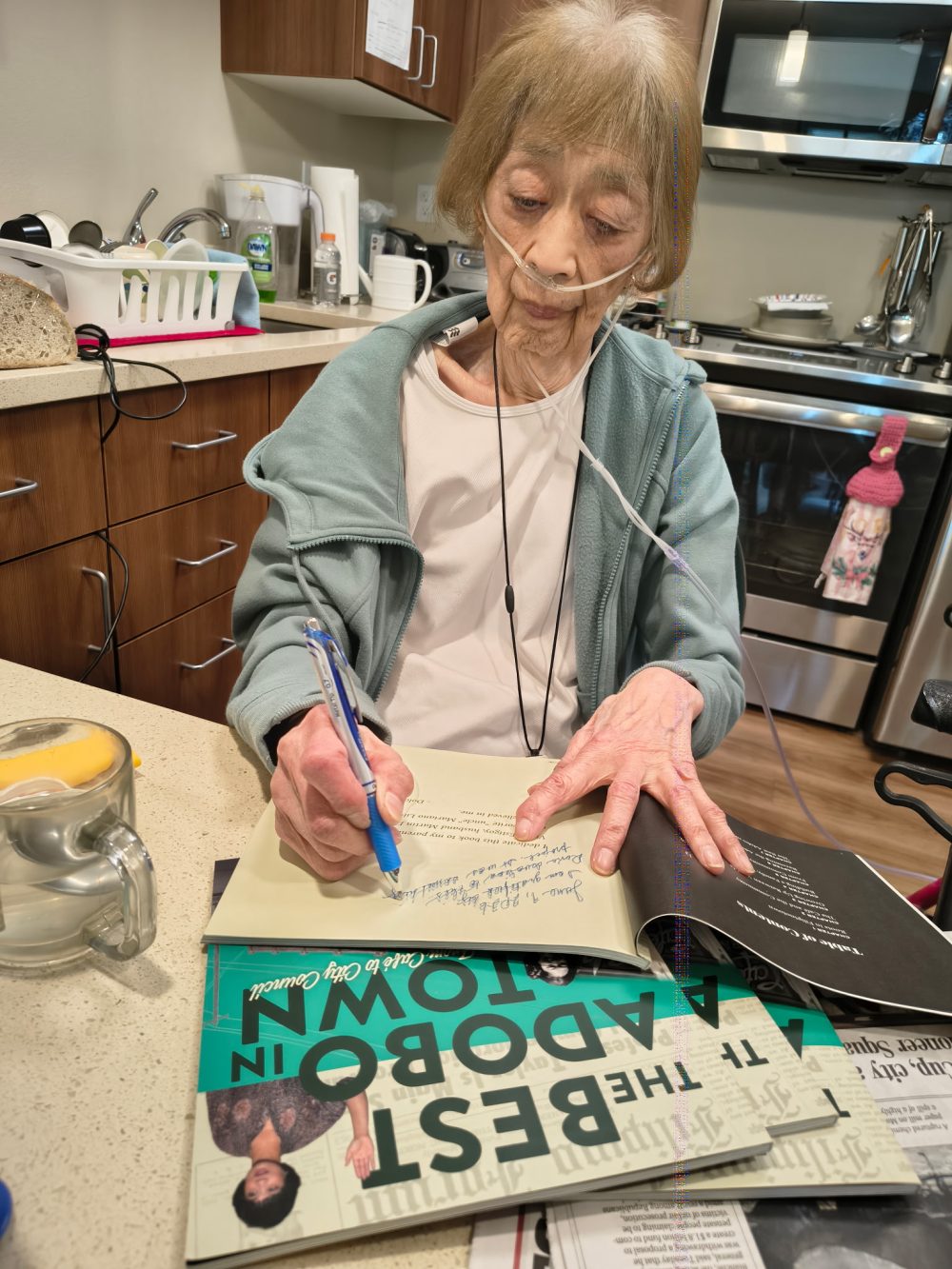
Despite Sibonga’s physical frailty, she was alert and spirited at the party. Since her memoir’s release three months ago, she has gained renewed vigor. She is busy welcoming old friends who stop by to catch up and are rewarded with a personally autographed copy of her book.
At the birthday, I pressed her to reveal the keys to her storied longevity and mental acuity.
She pointed out that she never retired. She cited her long tenure with the King County Board of Appeals. “I worked all the time,” she said. “I’m always interacting with people.”
What else? “I try to eat healthy. I was vegetarian for a time.”
I told her that I try to eat healthy, too. But why, I asked, do women almost always outlive the men? “Maybe so they can take care of the men as they get old,” she quipped. “Someone has to do it.”
She said she has been surprised that men have been picking up her memoir. ”I wasn’t expecting it,” she said. She said her Ethiopian hospice care worker Ken read it while he was driving home. “He shouldn’t be reading while driving,” she said. “But he said he appreciated the immigrant story. He recognized it.”
Sibonga also exercises regularly. This began when she was on the City Council. “Your whole body works well and your mind, too” she said. “I loved going to the police department gym. They would get pissed off when I went there. But this belongs to the City. There’s no reason the police have to occupy it 24-7.”
A final life tip: “I try to learn something from everyone. Every person has value. I learned that from the manongs in Chinatown. There was one gentleman who fixed clocks in his room. So talented. They had talent that was unrecognized. I thought, “What a waste!” It was a waste that these men weren’t afforded the opportunity and that they weren’t accepted. We could have been a much better people and country. “As I’ve said before, I’ve been lucky, very lucky. The door opens and I go through it.”
After the birthday party, I turned to Theresa and Randi to share what they have learned from their mother.
Theresa, a retired educator and counselor for the Seattle Public Schools, told me that she learned the importance of civil rights and advocacy for communities of color, especially students during their developmental growth phase.
Randi said that she learned compassion and respect for everyone. “Every person has value,” Randi said. ‘You never know what people have been through or what they’re experiencing now. Life is tough on everyone. And keep in mind that this is how connections happen—you never know who they are and who they know.”
I also asked Theresa and Randi for a few fun details most folks don’t know about their mom.
Theresa: “She is a Seahawks fan. I will receive a text asking for the time of kick-off and network covering the game. Each time the Seahawks make a touchdown, I will get a text from her with words, ‘woo-hoo’!”
Randi: “She is a huge re-gifter and often forgets who gave her what, which hasn’t always worked out well. She was a concert violinist in high school. She loves musicals. She never learned to ride a bike.”
Sibonga’s memoir was funded by the contributions of Asian American community friends and family. There are a limited number of copies available for free at the Wing Luke Museum. Those interested in making a financial contribution can direct it to the International Examiner, which served as publisher and editor.