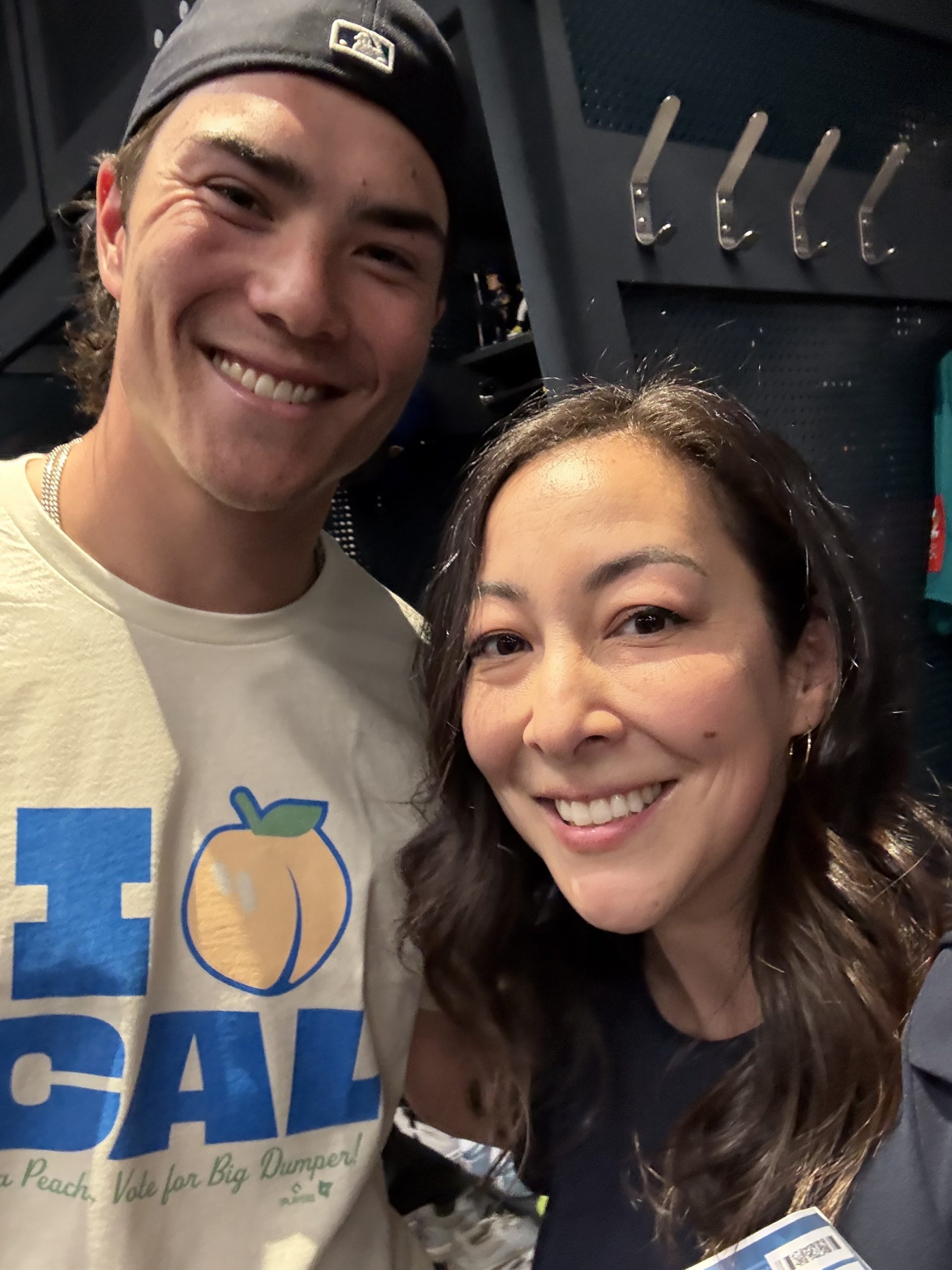
courtesy of Emily Hawks.
Bryan Woo is a starting pitcher for the Seattle Mariners. Born in Oakland, California, he attended California Polytechnic State University (Cal Poly) before being drafted by the Mariners in the 6th round of the 2021 Major League Baseball (MLB) Amateur Draft. He made his MLB debut in June 2023. Bryan is Chinese American on his paternal side, and was kind enough to share a bit about his cultural identity and how it has informed his perspectives on life.
Emily Hawks: You’re a lifelong West Coaster. You grew up in the East Bay, went to Cal Poly for college, and now you’re playing baseball in Seattle. You’ve been in lots of different clubhouses over the years, so what stands out to you about being a West Coaster in this game?
Bryan Woo: Obviously I haven’t spent a whole lot of time on the East Coast, but I feel like the West Coast is always pretty diverse. Growing up in the Bay Area was a really great experience of being exposed to a lot of diversity and different cultures. Cal Poly wasn’t quite as diverse, so it was a little bit of a change, and took getting used to it and seeing that it’s not always like that. Then getting lucky to come to Seattle, and being surrounded by some really good diversity and a bunch of different cultures. It’s something that I think I’ve learned to appreciate over time.
EH: I understand your grandparents were born in China and they immigrated as teenagers to the San Francisco Bay Area. How have their experiences as first-generation immigrants impacted your perspective?
BW: I think when I was younger, I didn’t quite appreciate it as I do now. We took a couple of trips to China when I was younger. On our first trip, I went when I was seven or eight, and we actually got quarantined. We had a two-week trip and we got quarantined for like nine or 10 days of it. So, we had to do a redo. When I was in high school, we went back, visited where my grandmother and grandfather grew up, their villages, and some of their family ancestors, community and stuff around that. That was a super eye-opening experience, and then after that I became a little bit more aware and tried to be a bit more open to learning about their path to where we are now.
EH: When you had your first start in San Francisco in 2021, you had a huge contingent of friends and family supporting you. Who would you say got you interested in baseball to begin with?
BW: I guess probably my parents put me in a bunch of sports. My dad’s side was all California, so they were all Giants, 49ers, Warriors, A’s; and then my mom’s side is East Coast, so she was all Red Sox and New England. So it was a mixed sports household, but I think everybody in my family really enjoyed sports. I just tried everything, and then baseball is what I ended up gravitating towards.
EH: The Mariners have had many different star players of Asian descent, I think probably none more prominent than soon to be Hall-of-Famer Ichiro Suzuki. I know Ichiro continues to be a fixture in the Mariners clubhouse and around the organization. What’s it been like having a front row seat to getting to know Ichiro?
BW: Yeah, it’s crazy. At first, it’s obviously super intimidating. Like the first time you see him, you are maybe a little bit standoffish, and you try to figure out how he operates around the team and the clubhouse. And then you slowly start to have conversations with him, and you realize how great of a guy he is — super kind, hardworking, and all that stuff. So I think a lot of it is just observing him from afar and trying to pick up on little things that he does, and how hard he works still. Even at his age, he’s still playing, and he does it all. It’s really, really cool to watch. It’s a privilege to have him here.
EH: We’ve mentioned your Chinese heritage, but I know you have a mixed-race background. I’m also Hapa (of mixed-race Asian descent), so I’m curious to hear how having that multicultural perspective has influenced your experience.
BW: Yeah, I think it’s nice. I think I try to learn as much as I can about both sides. I think I’ve learned more about my dad’s side just from being in the Bay Area. My dad’s whole side of his family is all in California or in the Bay Area where I grew up, so we spent a lot of time with them. But it’s nice because I think it makes you a little bit more aware of different perspectives and cultures. It’s not just one way or the other way. You start to realize that there’s different perspectives across the country. And you meet guys in the clubhouse, and you start to learn a little bit more about them and become more receptive to different walks of life.
EH: You’ve talked about how impactful it can be to see somebody who looks like you, who’s also doing the thing that you love. Now that you’re in a position where you might be that person to a young Asian or mixed-race kid watching you play, how does it feel to think of yourself as a role model, and a symbol of what’s possible for them?
BW: I mean, I think I definitely still am adjusting to it. I don’t feel like I am, but I think I’m slowly trying to realize that (I am), and be as good of a role model as I can be. I think just being outspoken about being proud to be Asian American and, you know, taking real pride in that. I think it’s a big thing that I struggled with growing up, and now it’s something I try to go into. And then just going about my work the right way, and being a good person, being a good teammate, all that type of stuff. And then hoping that those values and characteristics just kind of show up for themselves.
EH: So my last question: In an alternate universe where you weren’t playing professional baseball, what do you think you’d be doing today?
BW: I don’t know. I feel like I’d want to be involved in sports somehow. If I wasn’t playing, I think I’d want to be coaching or instructing or something. I feel like I knew in school there was nothing really that I was super passionate about, and I always wanted to be outside. I always wanted to be playing or doing something outdoors. So coaching or helping kids is something that I’ve always enjoyed. Making sure that whether it’s baseball or other sports, that gets passed down to the next generation. How I learned a lot of valuable lessons was through sports, so I try to do that for everybody else.