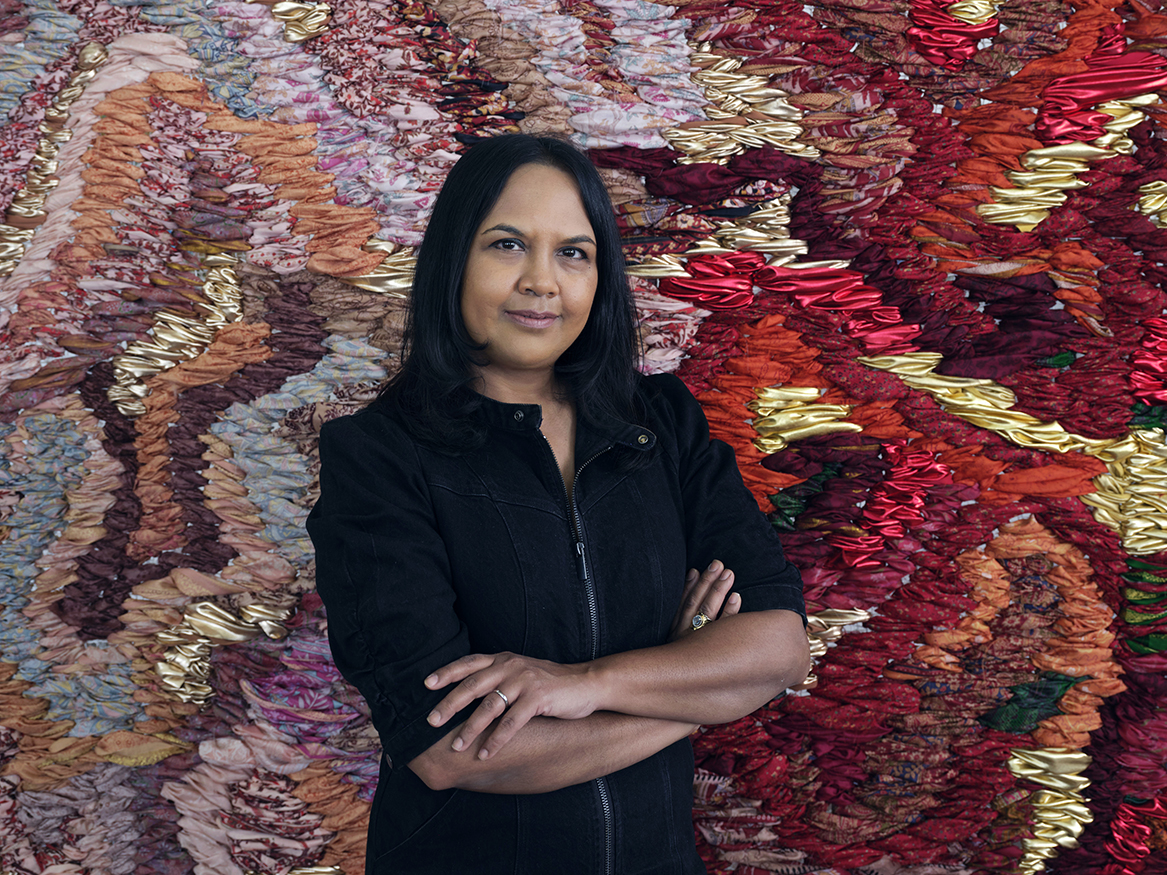
A vibrant pink Indo-Sarcenic arch serves as the portal through which I enter Suchitra Mattai’s she walked in reverse and found their songs (April 9 – July 20, 2025), a solo exhibit at the Seattle Asian Art Museum. The portal is physical, but it also symbolizes a metaphorical entry into Mattai’s internal memory journey, which I/we are privileged to access. This immersive exhibit draws me into a world where Holi and Carnival whirl in a feverish, dervish dance amid a symphony of sumptuous colors — kaleidoscopic fragments of gulabi (fuchsia) mango yellows, saffron oranges, and blues as turquoise as the Caribbean waters!
Pappy’s house (2024) in the first gallery anchors the exhibit, conceptually braiding themes of memory, storytelling, and reimagined worlds, resulting in dreamlike, dollhouse-like magic realism. The sculptural installation represents Mattai’s journey through the memories of her ancestral home in Guyana, paying homage to her South Asian roots, where twisted strips of vintage, recycled, and repurposed saris copulate with fabric embossed with bindis, sequins, embroidery, and gold thread, or zari. Everything shimmers! The heavily textured sari walls have an Impressionistic quality in their treatment of colors, and the roof (traditionally made from raffia in the Caribbean) is reimagined with gold tinsel. We can walk around the structure but cannot enter it, almost as if Mattai wants to keep cherished, intimate fragments of her memory within herself.
Mattai uses saris symbolically, a leitmotif that connects her pieces in the exhibit. The saris contain the scents and perfumes of the people who owned them, a “personification of people from the past, and the present.” She honors the ancestors’ memories in her artistic practice through these saris, many of which are gifted or donated by family and friends. While some are heavily embellished, like the silk and brocade wedding present from her uncle, others are plain, functional cotton saris that embody labor in the domestic space – cooking, cleaning, and working in the fields – all honoring women’s labor that is often invisibilized. Mattai honors the sewing, crafting, and embroidery skills she learned from her grandmothers, mother, and aunties. Mattai’s works are extremely labor-intensive, and it is only right that her labor in creating these beautiful works and that of her assistants in installing this exhibit are acknowledged.
In Pappy’s house, Mattai interrogates the complexities of home for diasporic peoples. Her ancestors were brought to Guyana from India as indentured laborers by the British after they abolished slavery in the Caribbean. Mattai navigates the multiple layers of her own diasporic experience, having moved from Guyana to Canada at the age of three and not returning since then.

I move to the next gallery in a dream-like state, caught between the overwhelming sensory stimulation of vivid colors and the internalization of Mattai’s interrogations of home and the migrant experience. The show is personal to Mattai. It “explores my own sense of belonging and the complexities surrounding the idea of home.” I connect with her meditations on a similar level because I am also an immigrant, often questioning the meaning of HOME – what/where is it for diasporic peoples who straddle multiple worlds, both physically and metaphorically.
The seven mixed-media assemblages include a self-portrait, furniture sculptures, and an abstract reimagining of everyday objects such as wooden clothespins in A Rich Life Lived (2024). In a self-portrait (2024), Mattai poses the question: if you had to create a self-portrait, what materials would you use, and how would you employ these materials to tell your story? The work features a central raffia panel adorned with two braids crafted from synthetic hair, and an allegorical family medallion at its center. On either side of the medallion are sari panels, with two additional braids tied at the ends with raffia ribbons.
The recurring presence of braids prompts me to reflect on their dual purpose and meaning. The straight, hanging ones evoke Mattai’s ongoing explorations of motherhood and matriarchy. The braids looped over the central raffia panel remind me of torans, auspicious door decorations in Indian homes, signifying welcome and good fortune for those who enter. The raffia leitmotif that appears in many of the works in the exhibit draws parallels (for me) with American artist Simone Leigh’s work. She pays homage to her Jamaican roots by utilizing raffia to explore themes of motherhood, the Black female identity, and the relationship between Indigenous materials and their use in traditional African architecture and crafts like basket weaving.
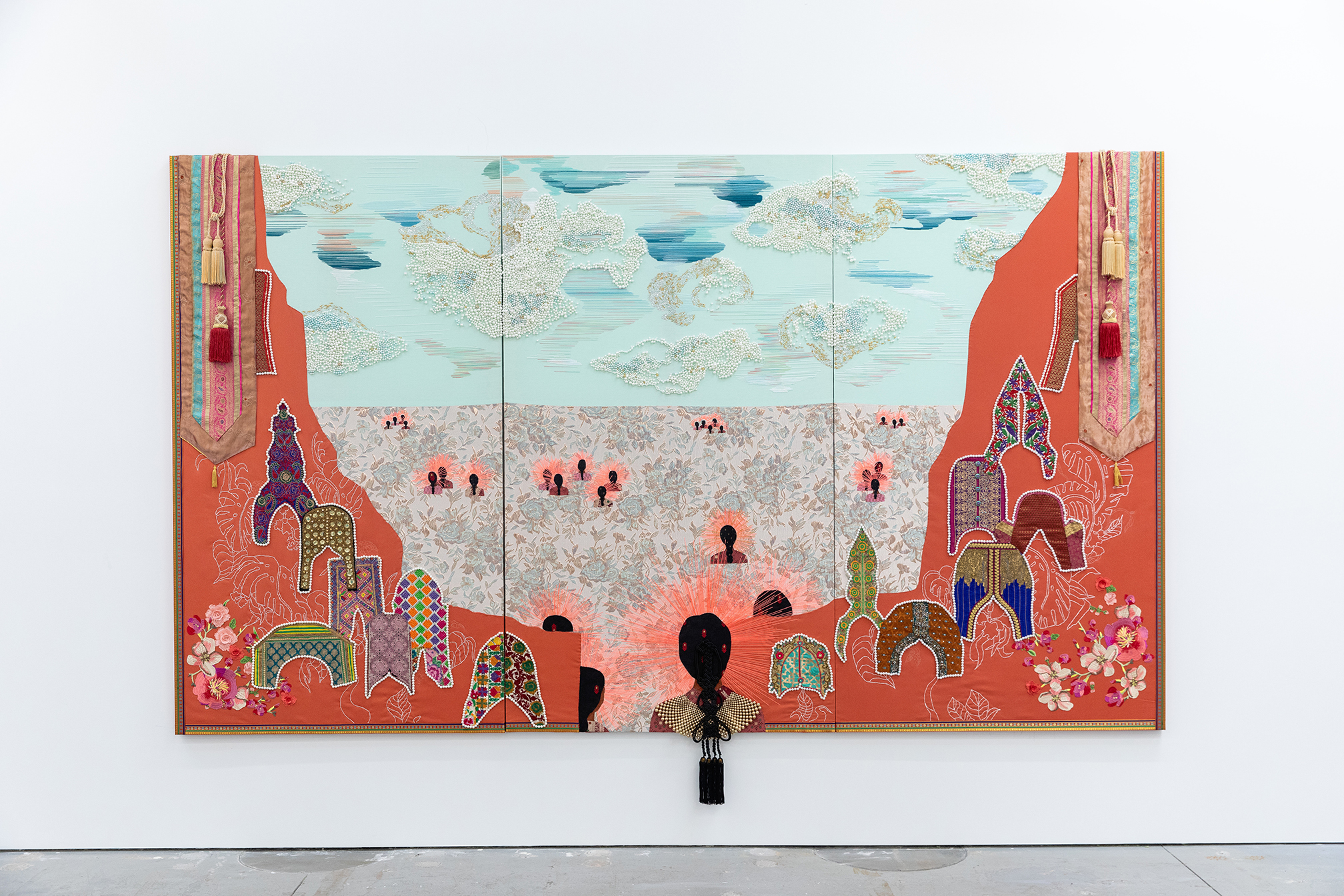
Two works move me deeply. the sea wall (2024), where Mattai recreates her imagining of her ancestors’ passage from India to Guyana and what they would have endured during that long, perilous journey, and memory palace (2024), a reframing of Pappy’s house.
the sea wall is an abstract landscape with islands floating in the ocean, created from faux pearls, bindis, and embroidery floss. Multiple iterations of women are shown with their backs to us, gazing out at the sea, dreaming of their freedom and futures beyond this seemingly impenetrable ocean wall. Mattai reconfigures the function of objects by reinterpreting them to assign them new meanings. Her work embodies a coded language; she transforms wooden clothespins, which symbolize domestic labor, into weighted anchors for the motifs in A Rich Life. Meanwhile, servant pulls are reimagined to represent motherhood and the mother-daughter bond. In my recent interview with Indian-American artist, Shruti Ghatak, one line resonated strongly – “An object once associated with restriction [becomes]a tool of limitless imagination.”
I head to the final gallery, where we conceptually revisit Pappy’s house, the starting point of the exhibit. However, this time, in memory palace, we are guided by Mattai into a new imagined interior of Pappy’s house, the site of undoing to create a new memory, a new mythology. While Pappy’s house felt impenetrable, memory palace presents a joyous, new way of thinking. It is fantastical and whimsical! We find ourselves in a magical, Alice in Wonderland-like world where gigantic balls of saris lounge on chairs, hang like chandeliers, and a ceremonial umbrella sits upright like a wise old man on a rattan chair with an ornate brocade seat cover, topped with a delicately crocheted doily.

Contrasting this joy, the video panels lining the sari walls take us deeper into Mattai’s memory journey. The looping video is a recording the artist made while traveling on a ship from India to Brazil, retracing her ancestors’ passage to Guyana. The Atlantic Ocean functions as a portal, offering a view that her ancestors might have had, filled with uncertainty about their destination as they left behind their previous lives. Mattai interrogates and reflects on this forced displacement of people from the Global South, highlighting the trauma of being uprooted from everything familiar and comforting.
memory palace is a liminal space. Humor roams here uninhibited, but it is also a space for deep reflection, a heavy passage where boundaries blur. Mattai’s ongoing contemplations of migration, displacement, ancestral memory, and myth become universal and accessible.
Mattai’s eponymous work she walked in reverse and found their songs (2024), emphatically disrupts the colonial narrative, engaging in a dialogue between past and future. The central figure, Diana, the protector of the enslaved, is portrayed as a brown woman. Her outfit is refashioned from a resplendent brocade sari, with pixelated cupids partly obscured behind richly embellished foliage. The background echoes an often depicted (in Western art) Greco-Roman/European pastoral scene.
Mattai’s manifesto is a “brown reclamation”!! She places people in spaces that have conventionally excluded them, challenging us to envision them in this new world that she creates. She asks, “How do we remain present while still thinking about the past, and into the future so we can find our ancestors’ songs that came before us?”
she walked in reverse and found their songs is an immersive exhibit that invites us to enter, dream, and reflect on the lives and his/stories of Mattai’s ancestors. She imagines a future that combines the glorious aspects of mythology and folklore, creating new vocabularies anchored in the past while looking ahead. Mattai disrupts, reframes, and re/imagines the narrative. She gently nudges us to embed ourselves in this visionary world of new myths, providing a luminous roadmap to navigate the ongoing complexities of identity and belonging faced by diasporic communities across the globe.
she walked in reverse and found their songs is showing at the Seattle Asian Art Museum from April 9 to July 20, 2025.