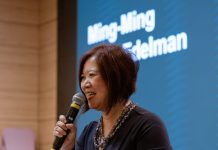
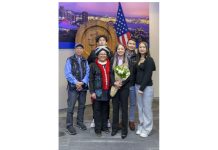
Ruthann Shigeko Kurose, a human rights activist and U.S. legislative aide who worked on the front line of the monumental campaign for redress payments to Japanese Americans incarcerated during World War II, passed away on October 15, 2026 at her Mercer Island home, surrounded by family.
“Ruthann was one of the unsung heroes of the Japanese American successful redress movement,” said Phil Tajitsu Nash, a close family friend who teaches Asian American Studies at the University of Maryland.
During the past decade and a half, Kurose’s health had steadily declined from Parkinson’s disease. She also fought through three bouts of cancer. She often joked with friends that, like a cat, she had been blessed with nine lives.
“The community has suffered a loss,” said Karen Seriguchi. She worked alongside Kurose, spearheading public testimony for the Japanese American Citizens League, which anchored the redress fight in the late 1970s and early ‘80s. “Ruthann approached people with an open heart. She was thoughtful and kind without being naïve. Professionally unflappable, but not indifferent.”
Kurose was born in Seattle on August 2, 1951. She attended Garfield High School. “Growing up in the Central District, she developed a commitment to cross racial lines,” said Marie Kurose, Ruthann’s sister. “Some of her early work was supporting the Black Power movement. In the early ‘70s, she worked with the Central Area Motivation Program in helping Black, Asian and other youth of color fill out financial aid and college applications.”
At the University of Washington, she majored in political science. She served on the news staff of the Asian Family Affair along with her brother Guy. “Ruthann started the Asian Drop-In Center in the early ’70s—a community center for Asian youth on Beacon Hill, located in the house that’s now Musang Restaurant,” Marie added.
Ruthann followed in the footsteps of her mother, Aki Kurose, a respected peace activist and beloved elementary school teacher in Seattle for 25 years. Her mother was incarcerated in the Minidoka concentration camp. Aki helped establish the Head Start program in this state. A south Seattle middle school now bears her name.
In 1978, Ruthann worked on the congressional campaign of Mike Lowry, sparked by his strong advocacy of Native American fishing rights and his willingness to support Japanese American redress. After Lowry’s win, he hired her on staff, making her the first Asian American aide for a Washington state congressional representative.
Ruthann helped organize congressional support for the first redress bill, introduced on November 28, 1979. Although it failed, Kurose doggedly organized and pushed for redress payments until Congress finally passed reparations in 1988.
“My guess is that she worked at least 60 hours a week on redress during the key years of 1979 to 1988,” said Nash. He had been hired by the Seattle-based Washington Coalition on Redress in 1983 to lobby for the bill. Nash said Ruthann relentlessly worked the phones, wrote press releases and letters and attended hearings, fueled by coffee and chocolate and regular evening runs between the D.C. Capitol and Washington Monument. Nash frequently joined her on the runs.
Nash pointed out that their grandmothers and their mothers were best friends.
“Our culture is fixated on the man who signs the legislation or delivers the stirring closing argument in a lawsuit,” Nash said. “But more often than not, it is people like Ruthann who provide the vision, the cohesion and the institutional insider knowledge to help justice campaigns such as redress move forward.”
In 1984, Kurose left Lowry’s office to join the city of Seattle as international trade and tourism coordinator. Dolores Sibonga, chair of the Seattle City Council finance committee, pushed for the position as part of the city’s economic development plan. In 1987, Kurose was appointed international affairs manager for the city of Tacoma.
After Ruthann married Nathan Rothman in 1988, she shifted her focus. Daughter Mika was born in 1988, and son Mori was in 1989.
She settled into family life but still managed to serve on many community boards, support social justice causes and mentor emerging leaders in the Asian Pacific American community. Her service included stints on the Seattle Center Advisory Committee, Seattle Art Museum advisory board, Bellevue Community College Board of Trustees, and State Liquor and Cannabis Board.
Rothman remarked simply, “She was much smarter than me.”
Mika and Mori Rothman recalled that their mother bought them to community meetings, protests, marches, and political events from the time they were barely walking. “She would plop us in the corner with coloring books while she engaged in important discussions like building political power for communities of color,” they said. When they got older, they attended Martin Luther King, Jr. Day marches. They came to rallies to support immigrant rights and volunteered at voter protection hotlines on Election Day.
Despite the challenges of Parkinson’s disease, Mika and Mori said, their mom continued to stand in solidarity with communities harmed by cruel and inhumane immigration policies. One of the last protests she participated in was with Tsuru for Solidarity at the Northwest Detention Center in Tacoma.
Joan Yoshitomi, community friend, added that Kurose was a member of the Asian Pacific Women’s Caucus. “Ruth Woo and Dolores Sibonga were the elder leaders,” Yoshitomi said, “and Ruthann was one of the younger leaders who inspired many of us to look at careers as aides in national and state politics. When she was on the liquor board, I know she was the one person who fought for Native American issues.”
Kristina Logsdon, aide to King County Council member Rod Dembowski, announced that the Council will adjourn its October 20 meeting in honor of Kurose.
Rothman commented on Ruthann’s legendary tenacity and commitment by pointing to a handwritten sign taped to a mirror in their bedroom:
Get up
Dress up
Show up – and
Never give up
Most recently, Kurose served on the advisory committee for the fundraising effort that resulted in construction of the Ron Chew Healthy Aging and Wellness Center as the first API aging-in-place facility in Washington state. The facility, located on North Beacon Hill, opened on November 10, 2025.
She is preceded in death by parents Aki and Junelow Kurose; brothers Roland Hiroshi Kurose, Guy Seiji Kurose and Hugo Tetsuo Kurose Kurose (all of Seattle); and is survived by husband Nathan Rothman (daughter Mika Leah Rothman and son Mori Roland Rothman), brother Paul Mitsuo Kurose, and sister Marie Haruko Kurose (husband Michael Woo), and grandchild, Kaiya Kok Rothman (daughter of Mika Rothman and Armand Kok).
Kurose’s family is planning a celebration of life for Ruthann after the end of the year.
Those interested in honoring Ruthann’s memory can donate to the Ruthann Kurose Scholarship Endowment Fund at Bellevue College. This fund supports students who have historically faced barriers to educational opportunity.
Donations can also be made at https://www.