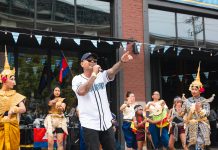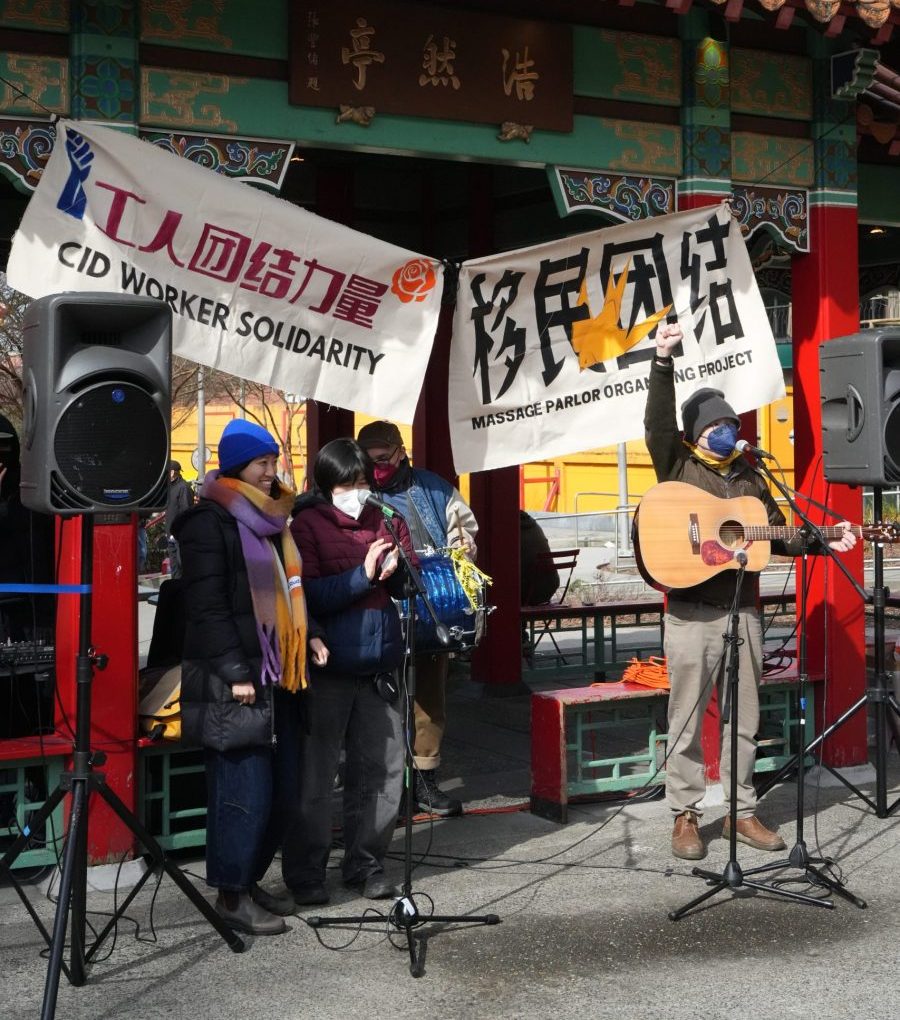
Project (MPOP) leads a protest song during a March 15 vigil at Hing Hay Park honoring the victims
of the Atlanta spa shootings of 2021. Photo by Hong Ta
The Massage Parlor Organizing Project (MPOP) will receive the Lifetime Achievement Award at the International Examiner’s 2026 Community Voice Awards. Please join us in-person, on October 22, 2026, to celebrate them and other community leaders.
Within the Asian American community, it’s easy to stand up for causes that are popular, like fighting against anti-Asian hatred. It’s another matter to advocate for those who are actively vilified and forced to live on the margins. Yet since 2018, the Massage Parlor Organizing Project (MPOP) has done exactly that: Building power for a community that is systemically excluded from institutional and governmental support.
This year, the International Examiner is recognizing MPOP with its Leadership in Community award for its efforts supporting nearly 700 massage parlor workers across Seattle and King County. The workers are predominantly migrant women from China and other Asian countries and face a variety of linguistic, legal and economic barriers. Due to their association with sex work, they are also subjected to criminalization and widespread social stigma. While many massage parlor workers do not engage in sex work, MPOP notes that they are often criminalized either way, and their labor is painted with a broad, racially charged brush. MPOP takes a stance of solidarity with these workers regardless of whether or not they engage in sex work.
Perhaps because of its members’ inherent precarity, MPOP is often at the vanguard of many social movements, raising the alarm about issues like surveillance and immigration enforcement years before they become mainstream. The organization believes that if we end the systemic exclusion massage of parlor workers, everyone will be freer. The International Examiner sat down with MPOP members JM Wong and Cindy Dong to discuss the group’s organizing and advocacy efforts.
Building a platform for workers’ voices
The original idea for MPOP grew out of an internship Wong had when they were studying occupational health. API Chaya, the Seattle-based anti-violence nonprofit, had asked Wong to do outreach to massage parlor workers after several high-profile police raids in the Chinatown-International District. Wong discovered there was a clear need for more support. So when their internship ended, Wong and several collaborators — including the late Emi Koyama — founded MPOP to create a permanent hub for massage parlor workers.
They started with several storytelling projects, collecting testimony from rank-and-file workers. MPOP also produced several zines in Mandarin to share resources, political education and knowledge of workers’ legal rights.
Wong says MPOP helped fill a void in the mainstream public narrative. Local media was only focusing on the salacious news of Asian massage businesses getting busted, but seldom highlighted the actual experiences and economic struggles of the workers.
“Many times when we’ve talked to workers, they tell us that yeah, they have the freedom to leave, but then they don’t leave because of broader structural [dynamics],” Wong said. “It’s not the single employer that is coercive, it’s the system and structure that is coercive.
After the 2021 Atlanta massage parlor shooting, in which a man shot and killed 8 people, including six Korean and Chinese female workers, MPOP held a vigil to honor the victims and call for justice. The group highlighted the ways that anti-Asian racism falls disproportionately on working class women, and especially those who are seen as sex workers. The new attention swelled MPOP’s ranks and underscored the urgency of its activism.
From outreach to labor organizing
As it’s grown, MPOP has shifted toward worker-led base building, inspired by the wider labor movement. To reflect this change, it also formally changed its name from “outreach” to “organizing” two years ago.
MPOP has worked with mainstream partners, passing a solidarity resolution against police raids at the MLK Labor federation this May. But it’s also looked to groups like Familias Unidas por la Justicia for a model on how to organize workers who, for various legal and institutional reasons, have been excluded from traditional labor unions.
A bulk of MPOP’s day-to-day work includes providing outreach and social support to massage parlor workers. Dong, a rank-and-file massage parlor worker, joined MPOP three years ago. She says that the group brought her a sense of belonging and newfound knowledge in her rights.
“I realized we deserve rights, and that there are things we can fight for and we can organize around,” Dong said, via interpretation from Wong.
One of MPOP’s main advocacy campaigns is its call for Safety not Stigma. Amid the resurgent moral panic, it is pushing back against the idea that criminalization helps victims of sex trafficking or sex workers.
Under the second Trump administration, conditions have worsened, with some massage parlor workers getting swept up in ICE’s crack down on undocumented immigrants. MPOP members visit detained workers on a regular basis to connect them with resources and legal support. According to Wong, workers at massage parlors that get raided are often more vulnerable to be targeted by ICE.
Reforming a discriminatory licensure system
MPOP is also spearheading a legislative campaign to change Washington’s massage licensing laws to make it easier for Asian migrant women to participate in the formal economy. Currently, prospective massage practitioners are required to take a test in English to receive certification. There is no option for test taking in Mandarin or other languages.
This is a relatively recent development — until 2012, Washington State law required an alternative examination option for people “who cannot read or speak English.” But a Democratic Party-sponsored law removed that provision.
MPOP says the licensure system is clearly discriminatory and designed to exclude immigrant workers. After all, massage is a science and art form practiced by cultures all around the world. It’s ultimately about stereotypes that Asian businesses and massage parlor workers are involved in sex work, Wong says.
“It’s so blatantly anti-Asian,” they said.
Dong is one of the massage parlor workers who hasn’t been able to get a massage certification due to language access. She says her clients can attest to her massage skills and expertise.
“Our skills are not measured by the licensure itself — a lot of us have experience from doing similar work in China,” Dong said. “Just because I can’t attain this license doesn’t mean that I don’t know how to do massage.”