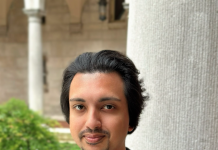
I sat down to talk with Karen Tei Yamashita, a Japanese American author of 10 books, many written in alternate structures, to find out the background of her newest book, Questions 27 & 28. She is a retired professor at University of California, Santa Cruz, and a Fellow of the American Academy of Arts and Sciences.
Yamashita grew up in a Japanese American community in LA, which she calls “the original JA (Japanese American) and Black ghetto, surrounding Little Tokyo.”
As Yamashita describes: “It was formative for me, but when my father, a Methodist minister, became ill, Mother took on the family support and moved us to Gardena, another JA area, a farm community that became a JA suburb.”
Then she went to Carleton College in Minnesota, where her mother had lived and worked after leaving Topaz incarceration camp during the war. There were other Japanese Americans there due to the Army camp for the Military Intelligence Service, so the young women and men met for social events.
The Carleton College president, a Quaker, had supported Niseis transferring to colleges outside the camps. Yamashita’s parents wanted her to leave California and Minneapolis seemed somewhat familiar. She said: “But I never lost my ties to California even though I was shell shocked by all the snow, November to March. In Minnesota I got a taste of living outside the JA community, and found an intellectual community.”
The author Alex Haley visited Carleton then but did not speak much about his famous new book The Autobiography of Malcom X. Instead, Yamashita became mesmerized as he told the long story of writing the book Roots by researching his heritage in Africa. The book’s amazing story was told through the voice of a griot, a West African storyteller.
Remembering this, Yamashita went to Japan for one year at Waseda University. She then spent the next half year studying her family roots there, before skipping through Hong Kong, Thailand and Europe.
“I was 20 when in Japan, traveling and discovering relatives on both sides of the family,” Yamashita recalled. She found her father’s family grave site near Gifu which went back 13 generations. “I went around with a photographer on a motorcycle to find my family roots.”
After she returned to college for one more quarter at Carleton, she applied for the Watson Fellowship in1974 and got a sizeable grant to go to Brazil to study Japanese settlement there. She studied works of Japanese Brazilian scholars like Hiroshi Saito, written in Portuguese. And she went to Sao Paulo to visit his institute, pursuing an anthropology study about the Japanese in Brazil. “Then I continued to live there, married the boyfriend I met there, lived there almost 10 years, had two kids.”
She researched her novel Brazil Maru but couldn’t get it published due to its experimental structure. She moved with the family to LA, worked for PBS, then wrote and published Through the Arc of the Rain Forest, an imaginative comedy with a fanciful cast of characters set in Brazil.
Yamashita pursued many experimental structures in her 10 books. “Coffee House Press in Minnesota always published what I wrote,” she explained. “I always was thinking, what if the narrators were of different genres?”
For I Hotel, about the advocacy and protest to save the International Hotel in Chinatown San Francisco, she commented: “It had to be a varied story, with sections for different communities: Chinese, Filipino, Japanese. I felt I could not tell it from one narrator, one genre. I interviewed over 100 people and each had a different way of experiencing that movement.”
She wanted “anybody to read it and find a story they could relate to. But I also wanted to challenge them and not ignore their intelligence, offer a way to see it from more directions.” Here, she refers to both the complexity and simplicity of mythology. The I Hotel book became a finalist for the prestigious National Book Award.
Next, she and her cousins worked on her subsequent book, Letters to Memory, based on letters written among her own Yamashita family members sent before, during and after the incarceration camp and relocation away from the West Coast.
Her latest book, Questions 27 & 28, imaginatively presents sections in different time periods, characters, voices and aspects of the incarceration. How did the book evolve? Yamashita explained: “It followed from the Japanese American section of the I Hotel book.
At UC Berkeley Bancroft library, she found boxes of records from the internment and read a lot of the original texts.
“Scholar Yuji Ichioka and other Japanese American sociologists wrote about the camps, as they were incarcerees, but also social scientists,” she said. So the actual Questions 27 and 28 on the questionnaire were developed from the social scientists’ interviews taken in camp, and evolved into the famous loyalty questionnaire asking about the inmates’ possible loyalty to the U.S. government versus. to the Emperor of Japan. Because they sought this data for the U.S. government, many of these Japanese American scholars were attacked by the other inmates for promoting the inquiry. So Karen wanted to look at this data processing, counting characteristics and personal/family practices that came from Japanese American academics, anthropologists and sociologists. And she believes these interviews and studies in the camps formed the social science that became the basis of ethnic studies.
There also are some fictionalized sections of the book, for example the imagined aspects of artist Isamu Noguchi’s half-year stay in Poston Camp, including conversations with futurist Buckminster Fuller. She wanted to see what Noguchi might have said about claiming a Nisei identity.
The reactions to Questions 27 & 28 have been slow so far, for example from incarceration specialists, activists and academics. Yamashita had sent the relevant book chapters to people involved with the subject matter. She mused that perhaps people want straight, not alternatively structured, history. She also said there has not been much reaction per se perhaps because Japanese Americans are reticent to express personal opinions.
Along that line, she points out the different experiences of Japanese Americans depending on where they grew up.
The West Coast has a long history of the tight-knit Asian ethnic enclaves. The East Coast has many Japanese American professional and academic transplants. In the Midwest, many Japanese Americans are people who left the camps and discovered new colleges and professions. Yamashita’s family was in that group.
Yamashita wanted to leave California for college, not feeling like a typical Japanese American. She then had to learn to speak up even more in a new intellectual testing ground at college after living in a Japanese community, which she feels was insular and parochial.
For her future writing, Yamashita is thinking about museums. What should they be? What should they collect and why?
When community members first started to envision and raise funds for the Japanese American National Museum (JANM) in LA, the question of “what should a museum collect” arose. She explained: “People wanted to donate things but how could the committee evaluate their worth as museum objects?”
For example, at Granada Incarceration Camp’s interpretive center, a local teacher instructed his high school students to curate the collection at the site. On the shelf sat a simple jug, which was surmised to make bootleg sake. Karen noted the importance of that unobtrusive item as a discussion point, and said at the Smithsonian Institution, a simple object shown can spur a complicated discussion.
She continued, “But interesting and also troubling stories are found behind cultural items or even body parts stolen from ancient cultural sites around the world, as you find in the great museums of Britain and Germany.”
So looking at the collection of JANM, what should be collected and viewed?
Yamashita says arguments about the Japanese American historical narrative are necessary. What parts of our history are important to us? Heated arguments are necessary, such as who gets to decide what is important? She has started this as a political study for her next book: curating a museum collection says what part of history is important to us, but that is based on who gets to tell the story.

Mayumi Tsutakawa is an arts writer and editor who often speaks and writes about the history of Japanese Americans including her family’s long history in Washington State. She was formerly head of grants for organizations at the Washington State Arts Commission and currently serves as an Asian film programmer for SIFF. Mayumi co-edited several multicultural anthologies, including They Painted from their Hearts: Pioneer Asian American Artists. (Photo credit: Humanities Washington)