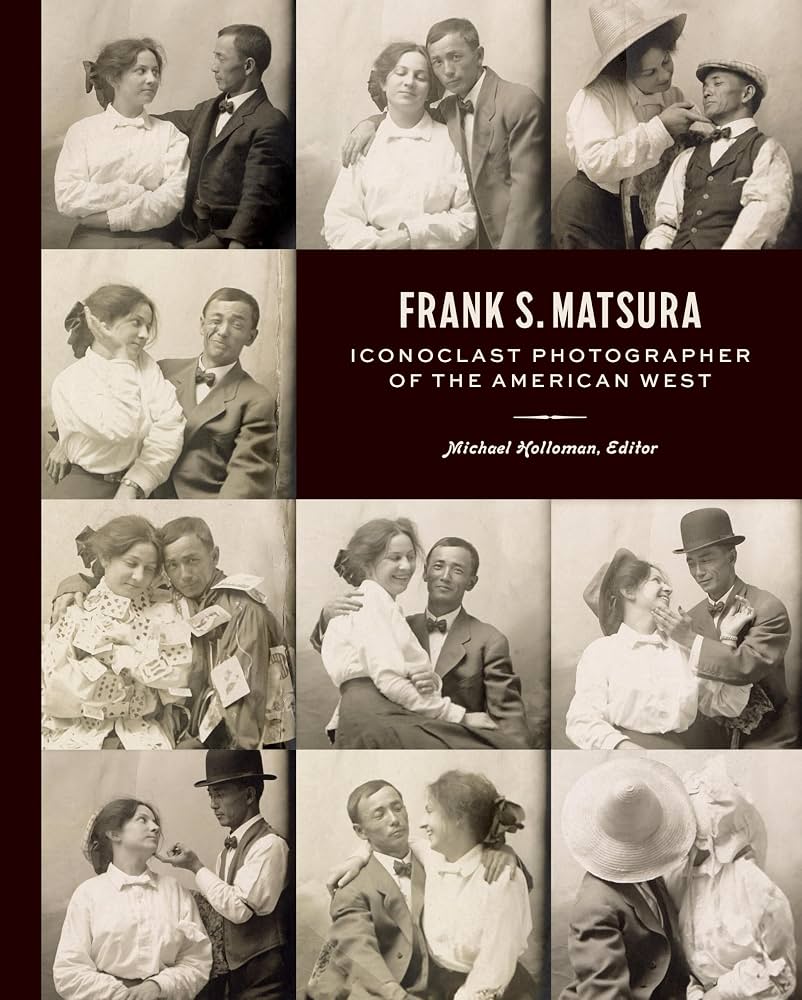
How does one assemble a book of essays about an artist whose life story is riddled with gaps? This is the question the essayists grappled with throughout Frank S. Matsura: Iconoclast Photographer of the American West, edited by Art History professor Michael Holloman and published by Princeton Architectural Press. The book’s subject, Frank S. Matsura, was a photographer who worked from 1903-1913 in Okanogan, a county in Washington that lies partially on the Colville Reservation and has been home to many Indigenous tribes. Matsura emigrated from Japan as a young man and made a living running a portrait studio and photographing landscapes for postcards. His career was cut short when he died at age thirty-nine due to tuberculosis. The essayists point out that we will probably never know Matsura’s motivation for emigrating, nor will we know his motivation behind becoming a professional photographer. Little is also known of his photographic training—as pointed out in the book, we only know that he bought his equipment right before he started working (he mainly used a 5″×7″ box camera).
Due to scant information about his life, the essayists mostly look at the context surrounding Matsura’s career and at his work itself. They examine the history of Okanogan and the peoples who have called it home, and the history of trick photography in Japan that potentially informed Matsura’s work. Maki Fukuoka, for example, describes how photography in Asakusa (a district in Tokyo) was utilized in performance art, which has similarities to performative aspects of Matsura’s photographs. Matsura’s photography is beautifully reproduced in the book and includes series of portraits, many of which are humorous or playful, taken both in the artist’s studio and in Okanogan. Landscapes and other nature photography are also featured, many of which served as advertisements to potential settlers. In readers’ minds, many of Matsura’s photographs may evoke contemporary selfies people take with smartphones. His photographs feel very casual despite being professional, a quality that the essayists discuss at length.
In the introduction, Holloman compares Matsura to Edward S. Curtis, one of his famous contemporaries, who also made his career photographing Indigenous people. That comparison is then explored by the essayists throughout the book. Curtis wanted his subjects to wear clothing that he deemed “authentic” even when they dressed differently in everyday life. He even provided them with costumes he felt would look Native American to a white audience. In contrast, the people who came to Matsura’s studio dressed the way they wanted to be dressed. Also, Curtis once removed a clock from one of his photos in order to frame Native Americans as relics or an ideal from premodern times. In Matsura’s work, the staging and props he offered to his subjects were their choice to use. It seems such a simple thing, but the contributors to this book highlight how depicting people as they want to be depicted is actually radical.
Regarding clothing and props, the fun Matsura was clearly having in many of the photographs (he took many self-portraits and frequently posed with his friends and subjects) was also emphasized by the essayists. For example, his photography features elements of drag. Women would be photographed spending time with their friends while wearing men’s clothes, and in one series of photographs, Matsura swaps conventionally masculine and feminine hats with one of his female friends. In Fukuoka’s essay, the drag elements and others are viewed through the lens of an op-ed by Matsura, which was a rare look into his thought process. In this surprisingly modern opinion piece he wrote in 1905 for the Okanogan Record, Matsura explained his belief that Japanese Buddhist and Confucian traditions contribute to the oppression of women. He also shared that throughout Japanese history, there were times in which women were educated alongside men and even hunted with them. He wrote that he hoped women would have opportunities like this in the United States.
On the one hand, Matsura’s work serves as a time capsule and window into the history of Okanogan and the Indigenous peoples of the Northwestern Plateau. But on the other hand, this book shows that Matsura and his work are still part of a living history. Beth Harrington, in her essay, realized this when she visited the area and found many people who think fondly of Matsura even after so many decades have passed. Notably, one Okanogan citizen even wrote in her family history about her family members being photographed in Matsura’s flower garden.
Frank S. Matsura: Iconoclast Photographer of the American West is an important book not only because it is a fascinating overview of Matsura’s work, life, and community, but also because it shows how examining a local artist can challenge prevailing narratives about both art and people. While reading this book, I kept wondering about the untold number of artists like Matsura who were well-known in their local communities but who have yet to be spotlighted, and about all the things they could also teach us.