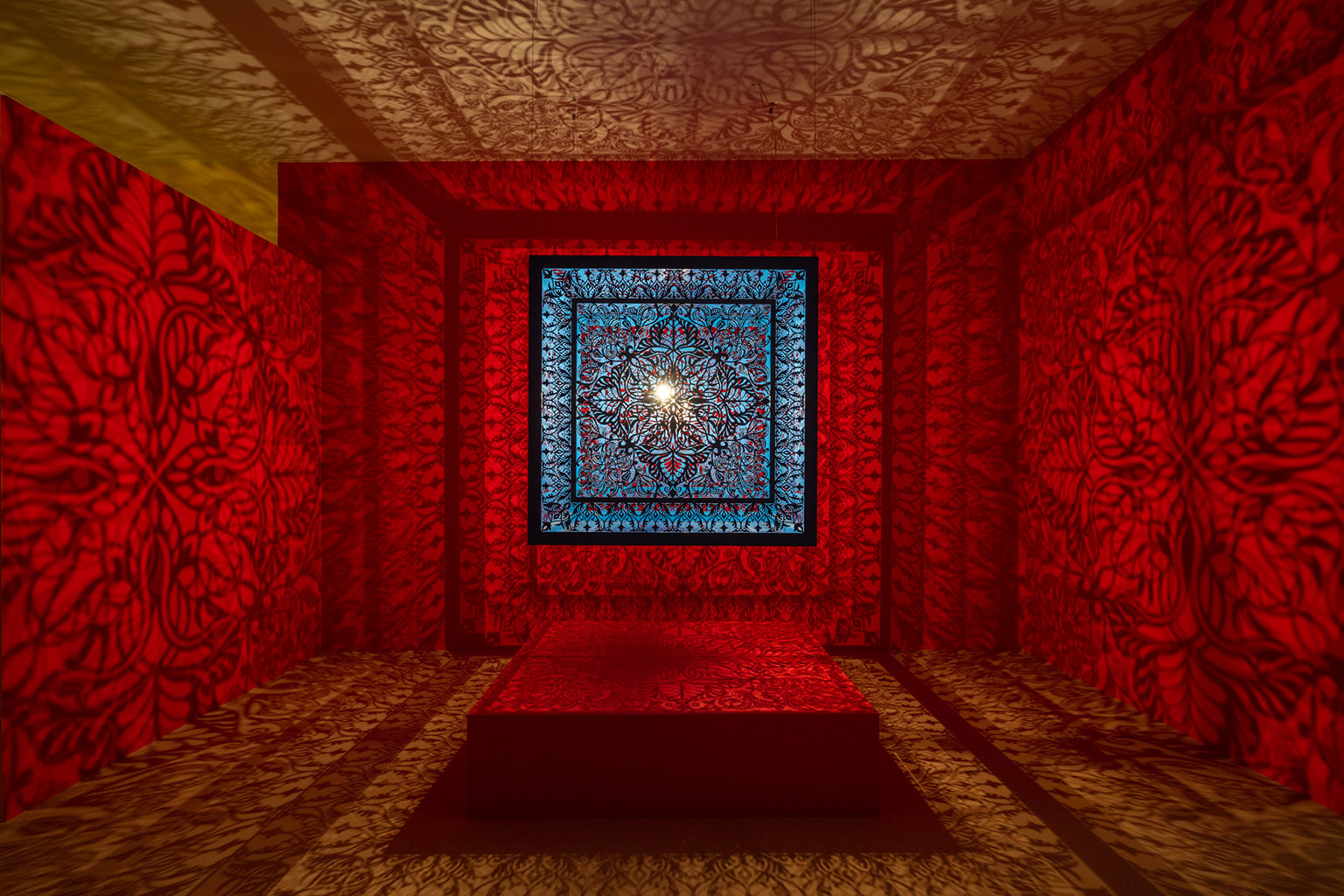
Sukoon, peace, calm—the word that comes to mind as I leave behind the snarl of Seattle traffic and step into a world where dancing, shadowy patterns wrap softly around me like a gossamer shawl. I embrace the stillness that settles in my body. I am at the Seattle Asian Art Museum to see Anila Quayyum Agha’s Geometry of Light, the first solo show by a Pakistani American artist in SAM’s 90-year history.
Agha’s work poses the question: How do you take a personal experience and make it universal? How do you move from the micro to the macro? From the individual stories to collective narratives? Agha’s artistic practice explores, interrogates, and disrupts universal themes of identity, belonging, gendered hierarchies, and freedom. She creates spaces that invite reflection on what connects us as global citizens.
Geometry of Light includes three large, illuminated sculptures and five smaller, mixed media works. Her laser-cut metal sculptures are inspired by the geometric patterns and motifs, as well as the play of light and shadow found in the Islamic architecture of her homeland, Pakistan. Agha’s fascination with pattern and texture deepened during her travels to Alhambra, a 13th-century Moorish palace in Spain, where she was submersed in spaces bathed with light filtering through latticed windows. She describes this transformative experience: “I just looked around and saw patterns of all types. It was on stucco, it was on the ceilings, on the tiles, it was in color. It was all around me, and I’m thinking: This is just so beautiful! Why would we disparage this beauty? That was the moment when I realized that I wanted to use all the different elements that I grew up with and bring them into one work to see if I could do it.”
The exhibit’s fuchsia and teal walls serve as striking backdrops for A Beautiful Despair (Blue), 2021, and This is Not a Refuge! (2), 2019, highlighting the interplay of dancing light, black and white, shadows, and patterns. There is a calligraphic quality to Agha’s work. It resembles intricate Islamic writing transformed into a three-dimensional laser-cut steel installation. What do they conceal? What do they reveal? She uses light and shadow as powerful metaphors—symbolizing women’s rights to literacy, education, and freedom of movement, shaped by her own experiences growing up in Pakistan amid restrictions on women’s presence in public spaces. Agha navigates the tension between illumination and obscurity, “the contradiction of light and shadow because you can’t have light without shadow and shadow without light.”
Presenting a single installation in each gallery allows the work space to breathe, to exhale a kaleidoscope of forms, patterns, and designs that are playful and precise. These arabesque shadowy patterns on the floor, walls, and ceilings beckon us inward, gently nudging us to immerse ourselves in a space that feels sensuous, infinite, and sacred. You are inside the light. The light is inside you. You become the light.

Sharing gallery space are the smaller mixed media works on paper, exquisitely detailed, delicate, and intimate—their intimacy accentuated by their conversation with the large sculptural installations. They feed off each other in the contrast of scale and grandeur, in their physical and metaphoric weight. Be Still My Heart II (2021), Of Love and Other Stories (2023), Dream Catcher II (2023), and Warhead II (2023) are embroidered, textured, and embellished, a nod to Agha’s training in textile design.
I meet Agha a few weeks after experiencing her show on a beautiful autumn day, where the expansive grounds of SAAM are bathed in shades of gold and amber. She speaks with fondness about the “sewing circles” that her mother and neighborhood aunties were a part of, where she learned sewing, embroidery, and quilting. This was also where she listened to stories from the older women on domestic violence, rape, and the near impossibility for women in Pakistan—and much of the sub-continent—to occupy public spaces without being subject to the male gaze and harassment.
Agha’s art is personal. It is political. Her mixed media works masterfully subvert the stereotype that embroidery and textile art are women’s art, “decorative,” “feminine,” and therefore “less important,” not worthy of being in the rarefied realm of contemporary art, notwithstanding that they are richly embedded with history, emotions, stories, and truth. She pushes back against these gendered notions of craft and art, against cultural gatekeepers who label crafts as decorative, where painting and sculpture are privileged over so-called “women’s art” entirely erasing their artistic integrity and merit. Her work refutes these artificial boundaries created by the self-anointed elites of the art world and reclaims textile art as a vehicle for authentic expression.
Her experiences as an undergraduate at art school in Lahore, Pakistan, and later as a graduate student in the US, exposed her to the dismissive attitudes of male colleagues, labeling her art as “too decorative, beauty was banal, and women’s crafts would not take me very far.” It was then that she realized the hierarchies within the art world and created a sharp-edged subversive visual vocabulary, layered with autobiographical nuance and cultural pride that elevates women’s art, which is her art! She decided she can “either conform and become like everybody else, or I can stick to my guns and make work that fits me, my paradigm, my life, my thoughts, and my politics. I started combining all these strands to create the work I do now and tell my story.”
This unapologetic resistance does not exist in isolation. It finds allyship in the art of other US-based South-Asian artists, such as Suchitra Mattai and Satpreet Kahlon, whose works similarly interrogate the often invisible, undervalued, and unacknowledged labor (and artistic merit) of women. Agha’s works are in conversation with Mattai and Kahlon on reshaping the discourse around who holds the power to define value in art.
There’s a certain generosity in the way Agha invites the viewer to engage with and interpret her work, offering them agency to become part of the art. She is intentional that her art and the space it occupies are accessible to everyone. It is important to her to create these spaces that are “conceptually challenging but physically inviting. That you are entering a space that is universal and belongs to all of us.” It is crucial in Agha’s artistic practice that the viewer can participate, and when they do, they are as valuable as the art. “They become the art!”
Geometry of Light is not an exhibit to be hurried through. Agha’s art invites pause and quiet reflection. It urges us to slow down, linger, and center our thoughts so we can explore and discover moments of magic that she conjures. Only then can we truly bear witness to her interrogations, her disruptions of what we perceive as “beautiful,” and who defines what is beautiful. Agha creates luminous, porous spaces for dialogue on belonging, identity, and accessibility—in its physical and metaphoric forms.
Anila Quayyum Agha’s Geometry of Light is on display at the Seattle Asian Art Museum through April 19, 2026.